
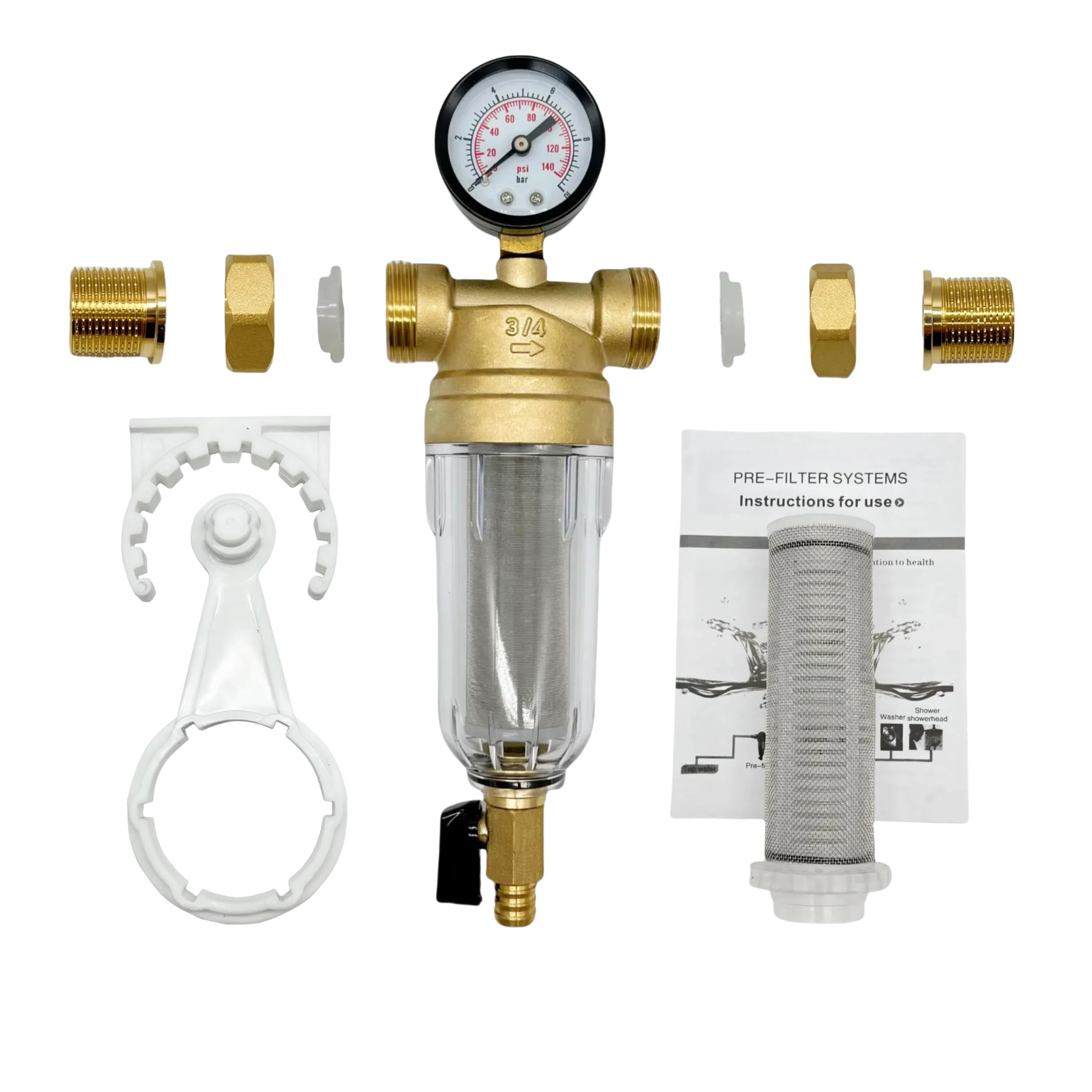
Whole-house sediment filtration is one of those upgrades that doesn’t get talked about much until you’re dealing with clogged faucets or a washing machine that keeps erroring out. A spin-down filter sits at the main water line and catches larger particles before they reach your plumbing. This particular model, with its 50 and 100 micron stainless steel meshes and integrated pressure gauge, is aimed at homeowners who want a low-maintenance first line of defense.
I’ve been testing this unit for a few weeks now, and the first thing that stands out is the build quality. The housing is solid, and the clear bowl lets you actually see what’s being caught. That might sound trivial, but it’s surprisingly useful—you know exactly when to flush without guessing. The pressure gauge is a nice addition, too. It’s not just for show; it helps you monitor when the filter is getting loaded. As the mesh collects debris, the pressure differential across the filter increases, and the gauge gives you a clear signal that it’s time to backwash.
The backwash process itself is straightforward. You open the bottom valve, and the water rushes through, spinning the mesh and carrying the sediment out. It’s not a full self-cleaning system—you’ll still need to occasionally take the mesh out and give it a more thorough rinse, especially if you have a lot of fine silt. But for routine maintenance, the spin-down action works well. It’s a far cry from replacing a cartridge filter every few months.
One thing to keep in mind is that this is a pre-filter, not a whole-house purification system. It’s designed to catch larger particles like sand, rust, and scale. It won’t remove dissolved minerals, chemicals, or bacteria. If you’re on well water with heavy iron or manganese, you’ll still need additional treatment. The 50 and 100 micron options are a good range for general sediment, but if you have very fine particles, you might find that a cartridge filter downstream is still necessary.
Installation is doable for a reasonably handy person, but it’s not a five-minute job. The unit comes with 1-inch male NPT threads and includes adapters for 3/4-inch connections, which covers most standard plumbing. You’ll need to cut into your main line and likely add some fittings. If you’re not comfortable with soldering or using compression fittings, a plumber is a wise investment. The clear bowl is also a bit of a double-edged sword—it’s great for visibility, but it can be a concern if you have water that’s prone to freezing. You’ll want to insulate it or install it in a conditioned space.
Compared to a traditional cartridge filter housing, this spin-down unit is a trade-off. Cartridge filters catch much finer particles, but they require regular replacement and can be messy. The spin-down is cheaper to operate over time—no replacement cartridges, just occasional cleaning. But it’s not as effective at polishing water. Many people use a spin-down as a first stage and then a cartridge filter as a second stage. That’s a solid approach if you have a lot of sediment.
Who is this for? If you have well water with visible sediment, or if you’re on city water that occasionally has rust or sand from aging pipes, this is a practical, durable solution. It’s also a good choice for protecting sensitive appliances like tankless water heaters or irrigation systems. On the other hand, if you’re looking for clearer, better-tasting water, or if you need to address chemical or bacterial contamination, this isn’t the answer. You’d be better off with a more comprehensive filtration system.
There are a few limitations worth noting. The pressure gauge is a nice feature, but it’s not a high-precision instrument. It gives you a general idea, but don’t expect laboratory accuracy. The mesh is stainless steel, which is durable, but if you have very aggressive water chemistry, it could corrode over time. And while the backwash valve works well, it can be a bit finicky to open and close—it’s a quarter-turn valve that requires a firm hand. Also, the unit is not designed to handle high flow rates continuously; it’s meant for typical household use. If you have a large property with high water demand, you might need a larger filter.
Overall, this spin-down sediment filter is a solid, no-nonsense piece of equipment. It does what it’s supposed to do, and it does it without a lot of fuss. It’s not a glamorous product, but it’s one of those things that quietly saves you from bigger headaches down the road. If you’re dealing with sediment issues, it’s worth considering. Just be realistic about what it can and can’t do, and you’ll likely be satisfied.