
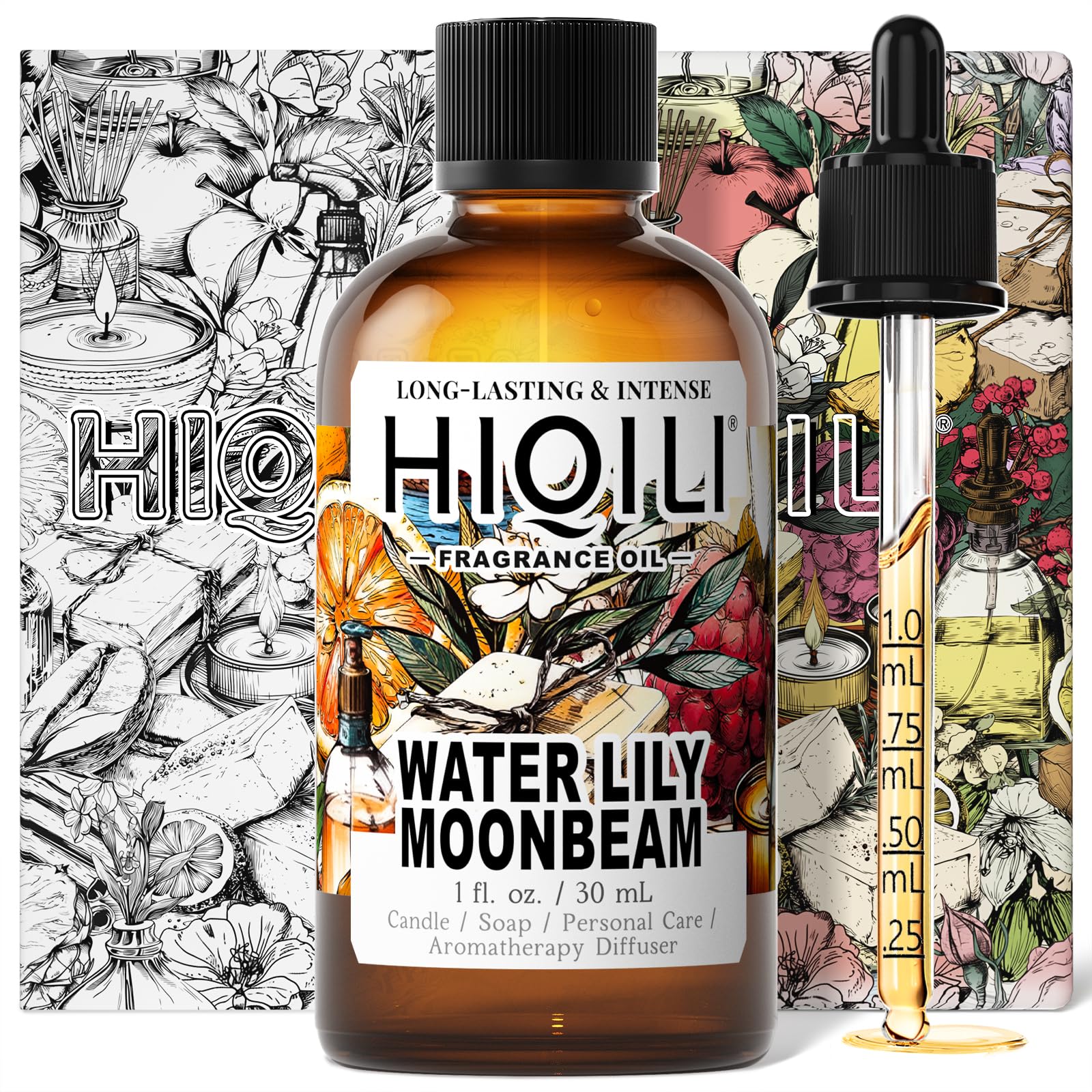
Fragrance oils occupy an awkward middle ground in the craft world. They are not essential oils, they are not perfume, and they are rarely sold with much transparency about what is actually inside the bottle. HIQILI’s Water Lily Moonbeam is a case in point: a synthetic fragrance oil aimed at the home-craft market, sold in a modest amber bottle, and positioned for diffusers, candles and soap. Whether it earns a place on your shelf depends heavily on how you plan to use it.
The scent itself reads as a soft aquatic floral. The opening is watery and green rather than sweet, closer to the smell of a lily pond at dusk than to a bouquet. There is a mild melon-like freshness up front, a heart that leans floral without becoming powdery, and a dry-down that is clean and slightly musky. It is deliberately inoffensive, which is both its appeal and its limitation. Anyone expecting the depth of a true lily absolute will find it thin; anyone looking for a background scent that does not overwhelm a room will find it well judged.
In practice, most buyers will use this in a reed diffuser or an ultrasonic diffuser first. In a water-based ultrasonic diffuser, a few drops carry a noticeable scent across a medium room for a couple of hours before fading, which is typical for fragrance oils of this type. In a reed diffuser, performance depends almost entirely on the carrier oil and the number of reeds, but the scent profile holds up reasonably well over several days. It is not a room-filling fragrance; it is a subtle one, and that should be the expectation going in.
Candle making is where the oil’s behavior becomes more variable. Fragrance oils sold for multiple applications are rarely optimized for every one of them, and this one is no exception. It blends into soy and paraffin wax without obvious discoloration in light-colored waxes, but the throw is modest at typical 6–8% load rates. Cold throw is stronger than hot throw, which is a common complaint with lighter aquatic florals. Increasing the load rate helps, but only up to a point before the wax begins to sweat or the scent turns slightly soapy. Soap makers should also note that some fragrance oils accelerate trace or discolor in cold-process soap, and while there is no dramatic reaction reported here, testing a small batch before committing a full loaf is the sensible approach.
One genuine trade-off is the lack of detailed ingredient disclosure. Like most budget fragrance oils, the bottle lists the scent name and basic usage guidance but not the full component list, allergen declarations, or IFRA certification details. For hobbyists making items for personal use, that is usually acceptable. For anyone selling candles or soap commercially, it is a real obstacle, since compliance documentation matters. This is not a flaw unique to HIQILI, but it is worth stating plainly rather than glossing over.
Compared with essential oils, this fragrance oil is more consistent and considerably cheaper per milliliter, but it lacks the botanical complexity and the aromatherapy associations that drive many buyers toward essential oils in the first place. Compared with premium fragrance houses that publish full safety data and offer sample sizes, it sits at the budget end: fine for experimentation, less suited to production work. Against other mass-market craft oils, it is roughly average in strength and above average in how clean the dry-down smells.
Suitable for:
- Hobbyists making reed diffusers, ultrasonic diffuser blends, or small batches of candles and melt wax
- People who prefer light, fresh aquatic florals over heavy gourmand or woody scents
- Buyers who want an inexpensive oil to test a scent idea before investing in a larger quantity
Not suitable for:
- Commercial makers who need IFRA documentation and full allergen disclosure
- Anyone expecting strong hot throw in candles without careful testing and higher load rates
- Buyers looking for a true botanical lily or a complex fine-fragrance accord
Overall, Water Lily Moonbeam is a competent, inexpensive fragrance oil that does what it claims within reasonable limits. It smells pleasant, behaves predictably in diffusers, and requires some patience in wax. It will not transform a candle line, but as a low-cost way to add a soft floral-marine note to home projects, it is a fair value—provided you test before you scale up.