
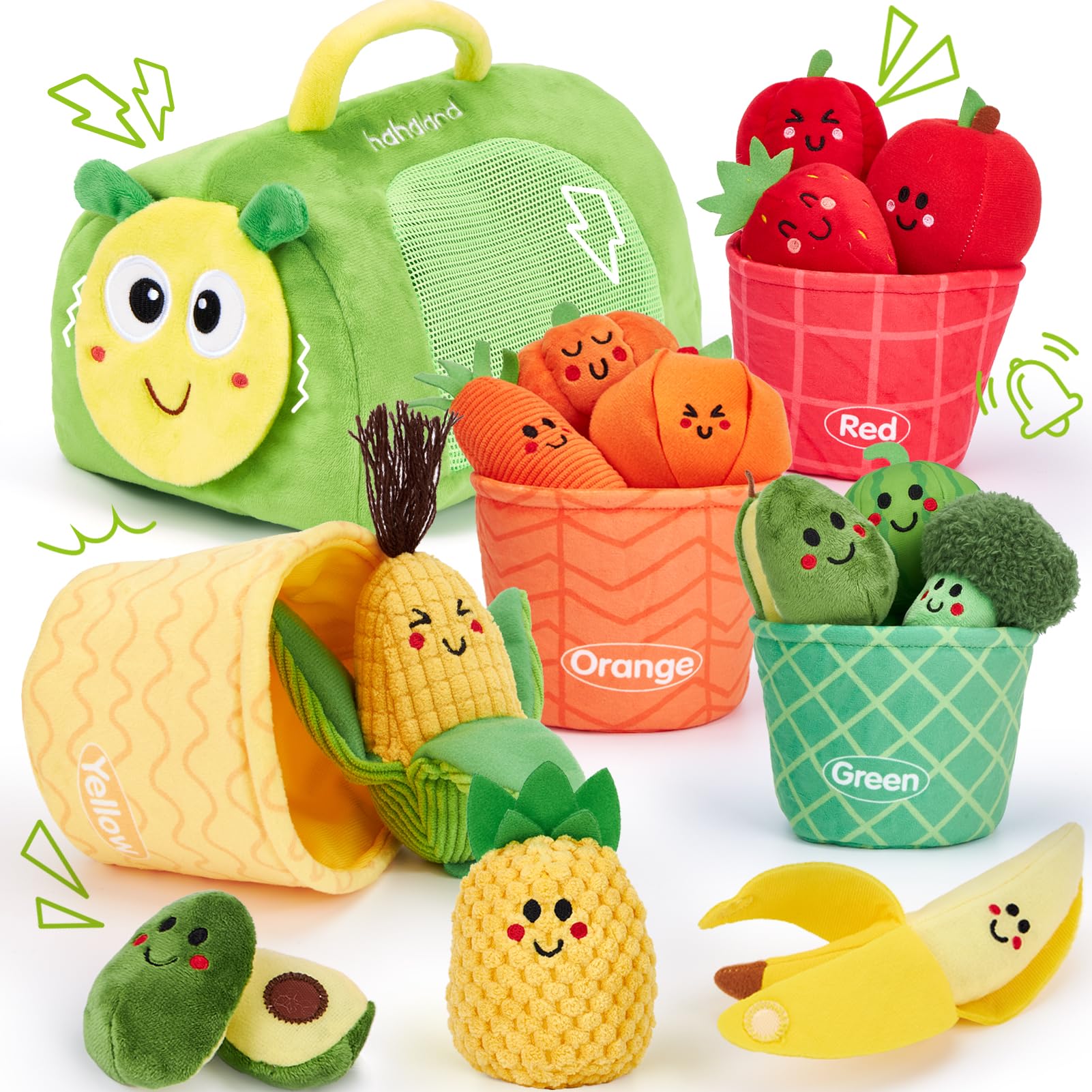
The Hahaland Montessori fruit and vegetable toy set sits in a crowded category of developmental toys aimed at babies from roughly six months to a year. It consists of soft, fabric-based produce items — the kind of thing you see in play kits marketed as “Montessori-aligned” — intended to support grasping, sensory exploration, and early pretend play. As with most toys in this bracket, the reality is more nuanced than the packaging suggests, and whether it earns a place in your toy rotation depends heavily on your child’s stage and your tolerance for fabric toys.
In practice, these toys get used in a few predictable ways. Babies in the six-to-nine-month range mostly treat them as teethers and grab objects: they squeeze the fabric, mouth the edges, and pass items from hand to hand. Parents often use them during tummy time or seated play as a way to encourage reaching. Closer to twelve months, the pretend-play angle kicks in — a toddler might “pick” the fruit, drop it into a basket, or hand it to a caregiver. That transition from sensory object to pretend-play prop is where the set has the most staying power, though it happens later than the marketing implies.
Functionally, the set’s main features are straightforward. The pieces are made from soft fabric with stitched detailing, which makes them lightweight and easy for small hands to hold. Many versions include crinkle material or a rattle element inside, providing auditory feedback when squeezed. The fabric construction means they’re generally safe for mouthing, and most are surface-washable. The fruit and vegetable shapes are recognizable enough to support naming games — “where’s the carrot?” — which is a common way parents use them to build early vocabulary. Compared to hard plastic play food, the soft construction is gentler on faces and floors, and there’s no risk of a heavy piece being dropped on a toe.
The trade-offs are worth being honest about. Fabric toys collect lint, drool, and crumbs, and while surface washing is possible, they don’t clean as thoroughly as plastic or wooden play food that can be wiped or rinsed. Over time, stitching at seams can loosen with heavy mouthing, and crinkle inserts can lose their crispness. The set also skews toward a narrow age window: it’s too simple for a confident two-year-old engaged in elaborate pretend cooking, and some younger babies simply aren’t interested in the shapes beyond a quick chew. Parents expecting a full Montessori curriculum in a bag will find this is really just a set of soft play-food items — useful, but not transformative.
It’s fair to compare this to wooden play food, which is the more common alternative. Wooden sets tend to be more durable, easier to clean, and hold up better for older toddlers, but they’re heavier, harder, and less suitable for a baby who mouths everything. Fabric sets like this one fill the gap for the under-one crowd specifically. Cloth books and soft blocks are another adjacent category — similar in material and sensory appeal, but less focused on naming and pretend play. If your priority is longevity, wood wins; if your priority is safe mouthing and light weight for a six-to-nine-month-old, fabric has a clear edge.
Who is this for? It suits parents of babies in the six-to-twelve-month range who want a soft, low-risk first play-food set and don’t mind the upkeep that fabric requires. It’s also reasonable for families who want to introduce naming and simple pretend play before moving to harder materials. Who is it not for? Parents of older toddlers who want durable play food for years of use will likely be disappointed, as will anyone who prefers toys that can be fully washed or sanitized. Families with pets that shed heavily may also find the fabric a magnet for hair.
Realistic expectations matter here. This is a modest, functional toy set, not a developmental shortcut. It won’t teach your baby to read a menu, and it won’t replace the value of real interaction — naming, pointing, and playing together is what makes it useful. Used as a supplement to everyday play, it does its job reasonably well. Used as a standalone “Montessori system,” it’s oversold. The set is at its best when treated as what it is: soft, chewable, nameable play food for the first year, with a lifespan that’s shorter than the box implies.