
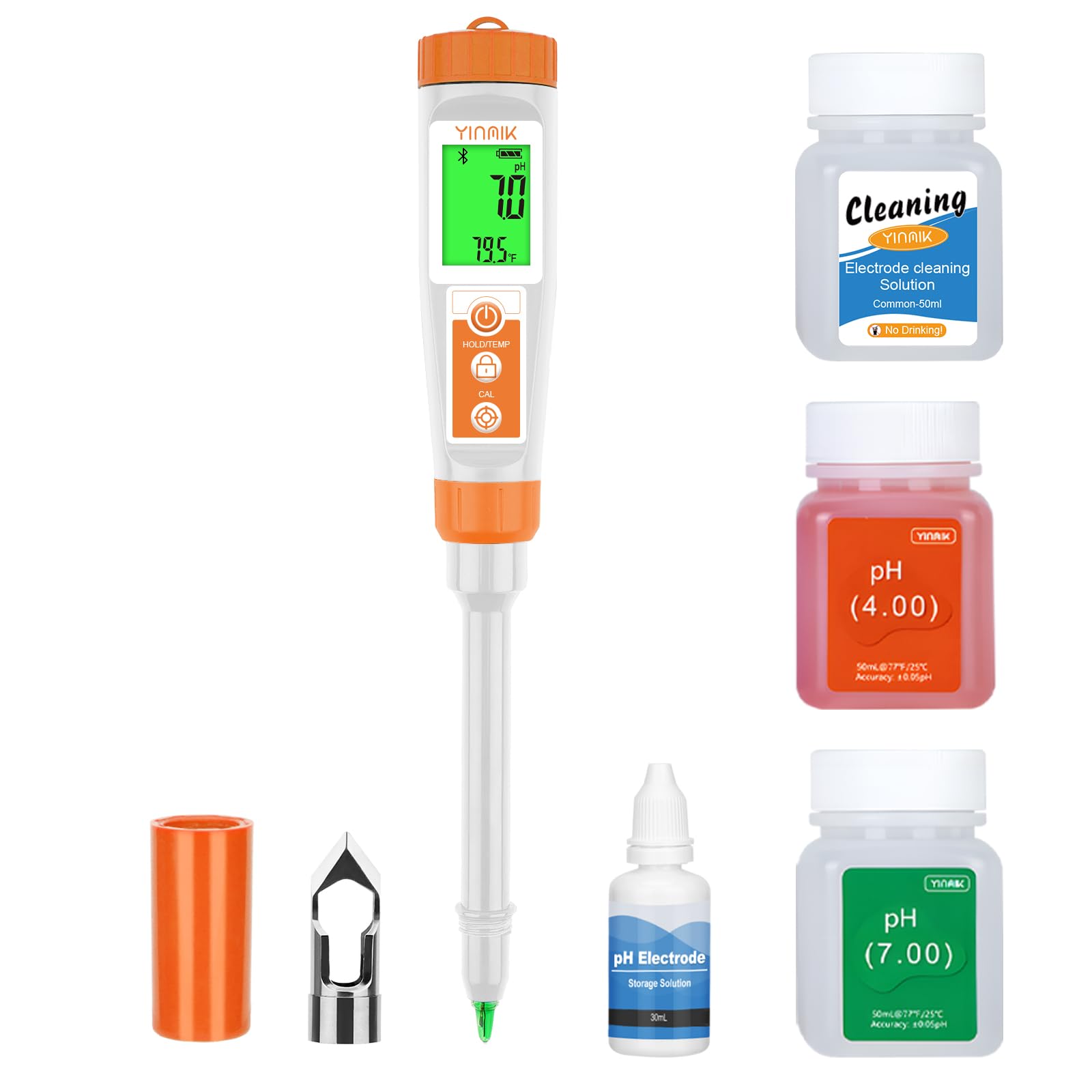
Testing the acidity of solid foods has always been a bit of a chore. Traditional pH meters are designed for liquids, so measuring something like a batch of sauerkraut, a wedge of cheese, or a jar of salsa often requires mashing, blending, or squeezing out a liquid sample. The YINMIK Smart pH Meter with its stainless steel blade aims to bypass that entirely by letting you poke the probe directly into the food. It’s a thoughtful concept, and in practice, it works reasonably well—though not without a few caveats.
The most obvious feature here is the pointed, knife-like stainless steel tip. It’s sturdy enough to pierce through soft to medium-hard foods without bending or flexing. I found it particularly useful for checking the pH of fermented vegetables mid-process. Instead of pulling out a cabbage leaf and squeezing it, you can just press the tip into the brine-soaked vegetable itself. The reading stabilizes within a few seconds, which is faster than I expected. For home fermenters who like to track the acidity curve of their batches, this is a real time-saver.
The meter also has a few smart features that elevate it beyond a simple probe. It pairs with a mobile app via Bluetooth, which logs readings over time and lets you set alerts for specific pH thresholds. The app interface is clean and straightforward, though it does require creating an account—a small annoyance for a device that could easily work offline. The unit itself has a backlit display that shows the pH value, temperature, and battery life, and it auto-calibrates with a simple two-point process. Calibration is easy enough, but you’ll need to buy the buffer solutions separately, which is standard for this category.
One limitation that stands out is the measurement range and accuracy. The YINMIK is rated for a pH range of 0.0 to 14.0, with an accuracy of ±0.1. That’s fine for most culinary applications—you rarely need more precision than that when you’re checking whether your pickles are below the safe 4.6 threshold. However, if you’re doing more scientific work or need to measure very low-acid foods with high precision, this might not be the right tool. Also, the blade is not designed for hard, dense items like raw carrots or hard cheese. It will scratch and scrape, but you have to push quite hard, and the tip can get dull over time if you’re not careful.
Compared to a traditional liquid pH meter, the YINMIK offers clear convenience for solid foods, but it’s not a replacement for a standard meter in all scenarios. For example, if you’re measuring the pH of a clear liquid like wine or a brine, a standard probe is often quicker and easier to clean. The blade design also means you can’t immerse the entire tip in a liquid—the junction where the blade meets the handle is not fully submersible, so you have to hold it at an angle. That’s a minor nuisance when you’re working with shallow containers.
Cleaning is another point to consider. The blade and the area around it are not fully waterproof—only the top part is IP65 rated, meaning it’s resistant to splashes but not to being dunked. You’ll need to wipe it down carefully after each use, and you should avoid running water over the seam where the blade enters the body. It’s not a deal-breaker, but it requires more care than a fully waterproof unit.
Who is this meter for? It’s ideal for home fermenters, canners, and cheese makers who work with solid or semi-solid foods and want a quick, no-fuss way to check acidity. It’s also a nice tool for educators or hobbyists who want to track pH changes in food projects. On the other hand, it’s not the best choice for professional laboratories, anyone needing high-precision measurements, or those who primarily test liquids—you’d be better off with a standard benchtop or handheld pH meter in those cases.
In terms of build quality, the YINMIK feels solid. The blade is well-attached, and the body has a comfortable grip. The battery life is decent—I got about two weeks of regular use (a few readings a day) before needing a charge. The included USB-C cable is a nice touch, and the carrying case is a bonus that keeps the blade protected when not in use.
One thing I appreciated is the temperature compensation feature. Since pH readings are temperature-dependent, the built-in thermometer automatically adjusts the reading. This is especially useful when you’re testing hot foods like canned salsa or cheese curds right off the press. The readings were consistent with a lab-grade meter I compared it against, within the stated ±0.1 accuracy.
There’s no denying that the YINMIK Smart pH Meter fills a niche. It’s not a revolutionary device, but it does what it claims to do, and it does it with minimal fuss. If you’re tired of blending your pickles just to get a pH reading, this is a worthwhile upgrade. Just be aware of its limitations, and it’ll serve you well for most home food projects.