
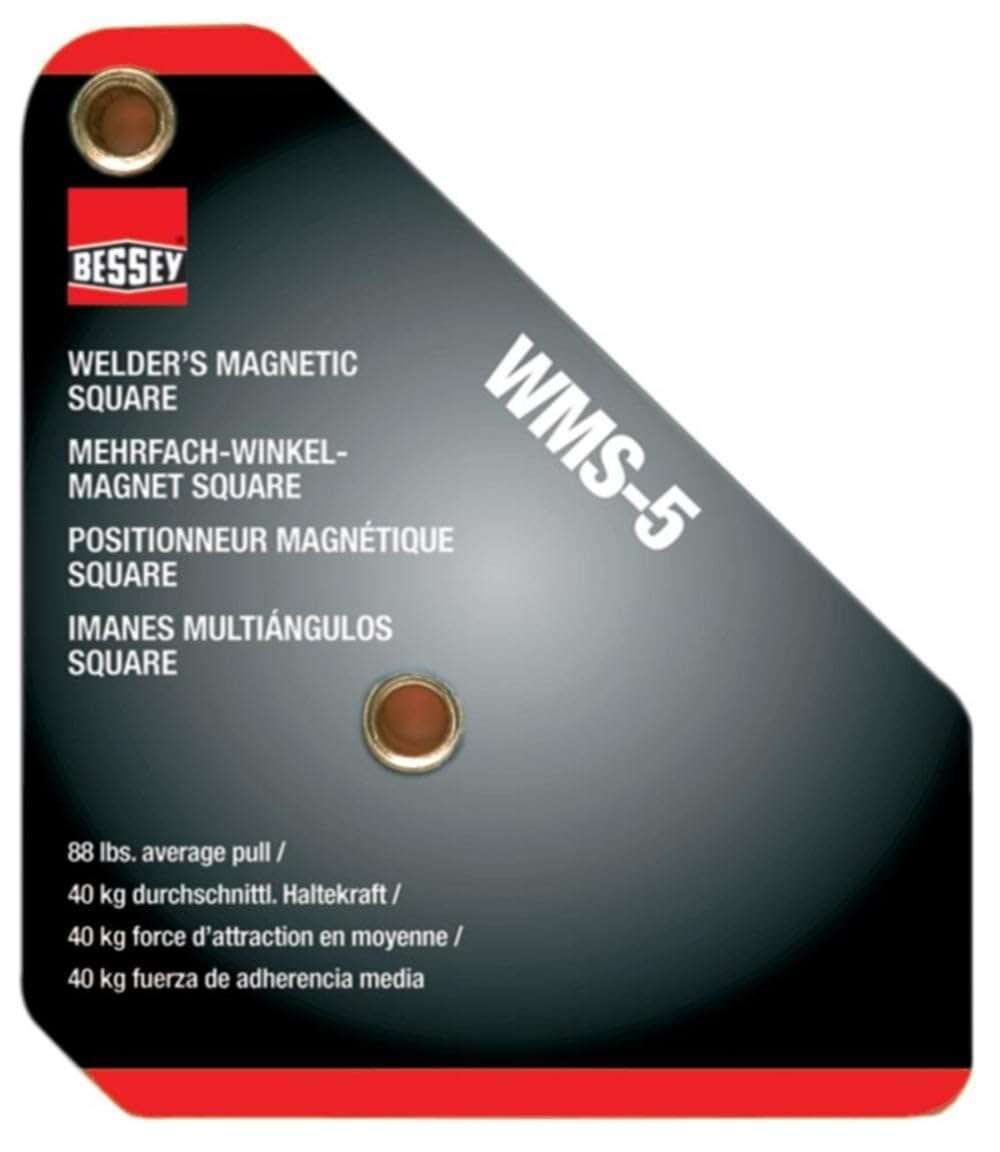
The Bessey WMS-5 is a magnetic hold-down square designed for welding, fabrication, and assembly work where two pieces of ferrous metal need to be held at a right angle while the user keeps both hands free. It is a small, purpose-built accessory rather than a general-purpose tool, and that focus shapes both what it does well and where it falls short.
In practice, the WMS-5 is used in the shop rather than on a finished project. A fabricator sets a vertical piece against a horizontal one, positions the square across the joint, and lets the magnets clamp the two surfaces together at 90 degrees. The user then tacks the joint, repositions the square, and repeats. It is most useful on light-to-medium steel stock: square tubing, angle iron, flat bar, and sheet. The value is in the setup: it replaces a second pair of hands and reduces the chance of a joint shifting between the initial tack and the final weld.
The functional design is straightforward. The body is a machined metal square with embedded magnets on the two inner faces, so the tool grips both workpieces simultaneously. Because the magnets sit in the body rather than protruding, the square can sit flush against the stock. The 90-degree reference is built into the casting, and the tool is sized to fit into inside corners and along outside edges. The magnetic hold is strong enough to keep parts from sliding under light handling, but it is not a substitute for a clamp when the joint is under load or when the parts are heavy.
That distinction matters. The WMS-5 holds alignment; it does not immobilize a joint against force. A common mistake is to treat a magnetic square as a clamping device. In real use, it is best paired with a tack weld or a separate clamp before any significant pressure is applied. Reviewers and fabricators who understand this get good service from it; those expecting a vise-like grip are usually disappointed. The magnets also mean the tool only works on ferrous metals. Aluminum, stainless in many grades, and non-metallic stock are outside its scope, which limits its usefulness in shops that work mixed materials.
Another trade-off is heat. The square is positioned close to the weld zone, and while it is intended to be moved before the joint gets too hot, the magnets and the body can be affected by sustained heat. The practical approach is to tack, remove the square, and complete the weld, which is how most people use it anyway. It is not a tool to leave in place through a full pass, and the instructions and common practice both reflect that.
Compared with alternative approaches, the WMS-5 sits between simple right-angle clamps and dedicated magnetic welding squares from other brands. A traditional machinist’s square or a combination square is more precise for layout and inspection but cannot hold parts. A C-clamp or welding clamp is stronger but slower to position and does not self-align to 90 degrees. Generic magnetic squares are often cheaper but vary in magnet strength and in how accurately the faces are machined; the Bessey name carries an expectation of better fit and finish, though the difference is incremental rather than dramatic. For occasional hobby use, a lower-cost magnetic square may be entirely adequate. For repeated production setups, the consistency of a better-machined tool has some value.
Build quality is consistent with Bessey’s general reputation: the body feels solid, the faces are clean, and the magnets hold evenly. The size is compact enough to store in a toolbox drawer and to fit into tighter corners, which is a genuine advantage on smaller assemblies. The trade-off of that compact size is that it covers less surface area, so on large or heavy sections the hold is proportionally weaker and the user will want additional support.
The WMS-5 is suitable for welders, fabricators, and serious hobbyists who regularly assemble ferrous metal at right angles and want a fast, repeatable way to hold alignment during tacking. It is also useful for general assembly and repair work on steel where a hands-free 90-degree reference helps. It is not suitable for those working primarily in aluminum or non-ferrous materials, for anyone who needs a true clamp rather than an alignment aid, or for users who expect a single tool to handle heavy stock without additional support. Buyers should also weigh whether the price premium over generic magnetic squares is justified by their volume of work; for light, occasional use, the difference may not pay off.