
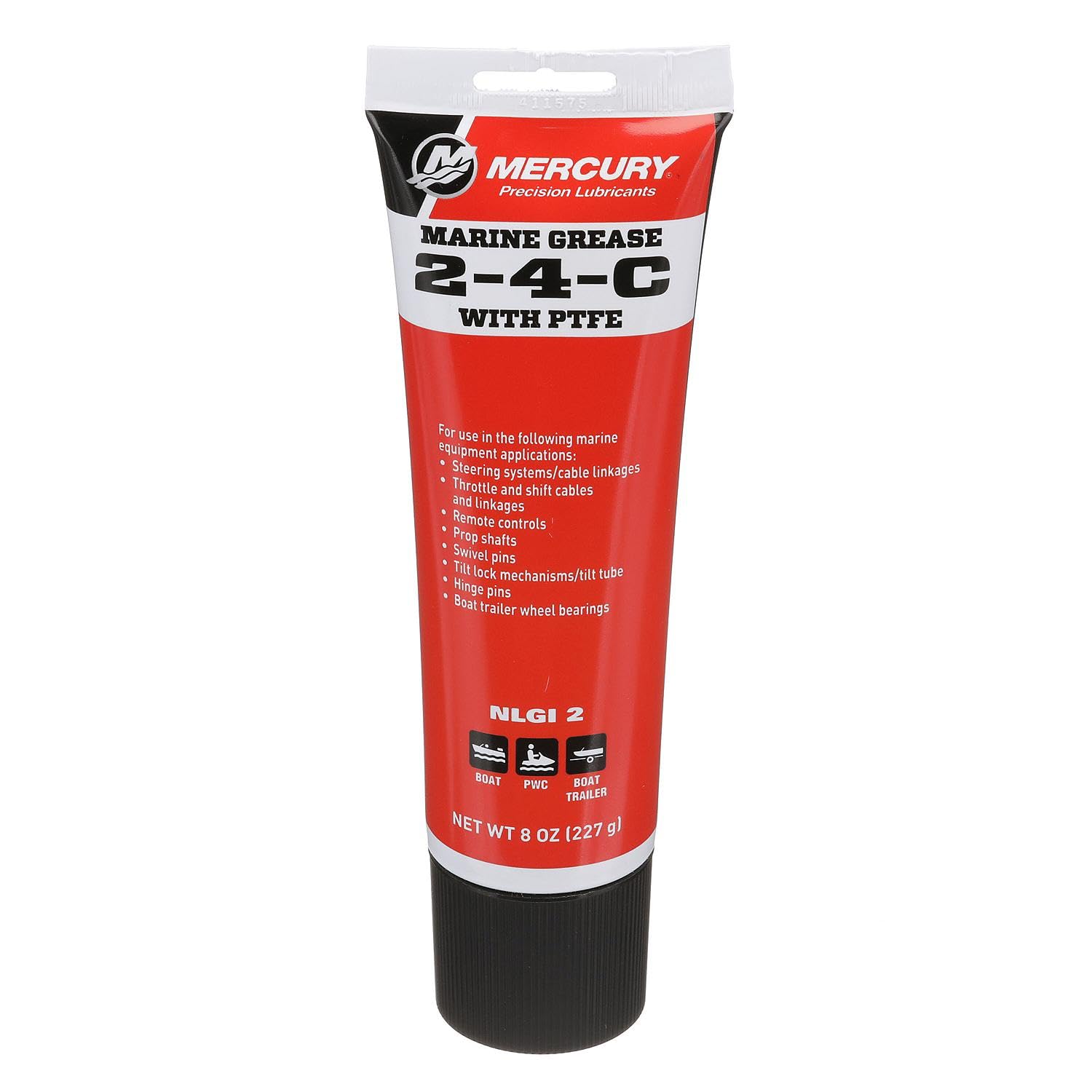
Mercury’s 2-4-C marine lubricant, packaged with the 92-802859A 1 part number, is a multi-purpose grease that has been a staple in boat maintenance for years. It’s designed for use in a variety of marine applications, from propeller shafts to steering components, and is often recommended by Mercury for their outboard and sterndrive engines. But how does it actually perform in real-world use, and does it justify its place in your toolbox? This review takes a neutral look at the product’s features, limitations, and suitability.
In practice, 2-4-C is typically used for lubricating points that require a water-resistant grease. Boat owners apply it to propeller shaft splines, tilt and trim pivot points, steering cables, and other moving parts exposed to saltwater or freshwater. Its formulation is intended to resist water washout and provide corrosion protection, which is critical in marine environments. The grease is available in a standard 8-ounce tube (the 92-802859A 1 is the Mercury part number for the tube), making it convenient for use with a grease gun or for manual application.
Key functional features include its water resistance, which helps it stay in place even when submerged or splashed. It also contains corrosion inhibitors to protect metal surfaces from rust and oxidation. The grease has a moderate viscosity, allowing it to adhere to surfaces without being overly thick, and it’s compatible with most common seal materials. Mercury specifies that it meets their requirements for certain applications, though it’s not a one-size-fits-all solution for every marine lubricant need.
One limitation is that 2-4-C is not a high-temperature grease. For applications like wheel bearings on trailers or other high-heat environments, a different lubricant with a higher dropping point would be more appropriate. Additionally, while it’s water-resistant, it’s not completely waterproof; in continuously submerged applications, it may eventually wash out, requiring more frequent reapplication. Some users have noted that the grease can be somewhat stringy and messy to apply, especially when using a manual grease gun, but this is a common trait of many marine greases.
Compared to alternative products such as a generic lithium complex grease or a specialized waterproof grease like those from other marine brands, 2-4-C holds its own in terms of corrosion protection and adhesion. However, it may not offer the same extreme-pressure properties as some high-performance greases. For typical recreational boating, it’s more than adequate, but for heavy-duty commercial use, you might want to consider a grease with a higher load-carrying capacity.
Who is this for? It’s suitable for recreational boaters who perform their own maintenance and want a reliable, Mercury-approved grease for routine lubrication tasks. It’s also a good choice for those who prefer to stick with OEM products to avoid compatibility issues. However, it’s not ideal for someone looking for a single grease to handle all possible applications, including high-temperature or extreme-pressure scenarios. And if you’re on a tight budget, there are cheaper alternatives that may suffice for basic needs, though they might not offer the same level of corrosion protection.
In summary, Mercury 2-4-C is a solid, dependable marine grease that does what it’s designed to do without much fuss. It’s not without its limitations, but for the average boat owner, it’s a practical choice for keeping moving parts lubricated and protected. Just be aware of its boundaries and use it where it makes sense.