
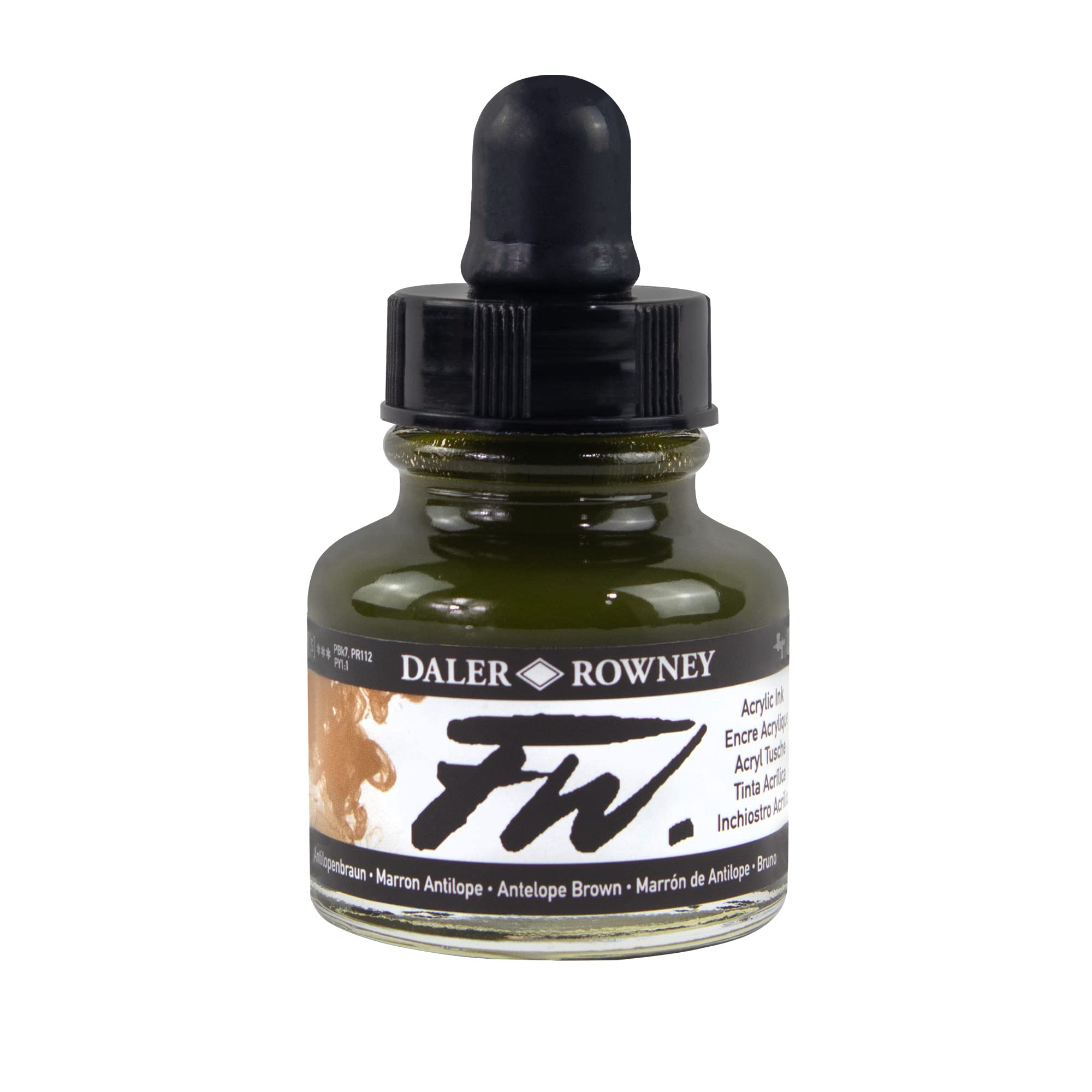
Daler-Rowney’s FW line of acrylic inks has been a fixture in illustration studios and art classrooms for decades, and the Antelope Brown shade is one of those colors that tends to earn a permanent spot on the desk rather than getting buried in a drawer. It sits in an interesting middle ground between a warm earth and a muted ochre, and how it behaves depends a great deal on how you apply it.
The ink ships in a one-ounce (roughly 30 ml) glass bottle with a dropper-style cap. That format matters more than it might seem. Unlike a brush-pen or a marker, you dispense the ink deliberately, which makes it easy to mix small quantities, load an airbrush, or refill a technical pen without waste. The dropper also means you can control dilution precisely when you want a wash rather than a solid line.
In practice, FW ink is pigmented acrylic, which means it dries to a water-resistant film. Once cured, it will not lift with water the way gouache or watercolor does. That is the central fact of working with it, and it shapes nearly every use case. For layering, glazing, and mixed-media work where you want a layer to stay put, this is a real advantage. For anyone who relies on re-wetting, blending wet-into-wet, or lifting color with a damp brush, it is a limitation worth understanding before you buy.
How it actually gets used
The most common applications are dip pens, technical pens, and brush work on illustration board or watercolor paper. The ink flows well from a nib and holds a crisp edge, which makes it useful for line work, lettering, and inking comic pages. Because it is acrylic, it also bonds to surfaces that would reject watercolor, including primed canvas, wood, and some plastics, which is why it turns up in mixed-media and craft contexts. Airbrush users thin it and report reasonable results, though the pigment load means you should filter or strain it if you are running a fine nozzle.
Antelope Brown itself is a workhorse color. It reads as a warm, slightly desaturated brown with an earthy cast, useful for skin tones in illustration, sepia-toned sketches, and as a mixing component for darker neutrals. It is not a vivid or fashion-forward hue, and that is largely the point. It behaves predictably when mixed with yellows to warm it or blues to cool and darken it.
What to expect from performance
- Opacity is moderate. On white paper it covers respectably, but on dark or colored grounds it will not fully hide what is underneath without multiple passes.
- Drying time is fairly quick, which is good for layering but unforgiving if you are trying to blend on the page.
- Water resistance after curing is strong, though fully saturating a thick application can still soften it slightly.
- Pigment settles in the bottle, so shaking or stirring before use is not optional.
- The one-ounce bottle lasts a long time for line work, less so if you are filling large areas or using it as a wash.
One trade-off worth naming: the permanence that makes FW ink useful for layering also makes it less forgiving. Mistakes set quickly, and correcting them usually means painting over rather than wiping away. Artists coming from watercolor or gouache often find this adjustment takes a session or two. The ink can also clog technical pens if left to dry in the mechanism, so cleaning pens promptly is part of the routine.
How it compares
Against watercolor, FW ink is more permanent and more saturated, but it lacks the reworkability and subtle granulation that many painters value. Against alcohol-based markers, it offers finer control and better mixing but requires more setup. Against standard India ink, it is more versatile across surfaces and easier to thin, though it is generally less opaque at full strength. In the broader acrylic-ink category, FW is a mid-priced, widely available option rather than a specialist or premium one, and the Antelope Brown shade is a sensible, mixable earth tone rather than a standout color in its own right.
Who it suits and who it does not
This ink is well matched to illustrators doing line work and inking, mixed-media artists who want permanent layers, and anyone who needs a reliable warm brown for skin tones or tonal sketching. It is less suitable for painters who depend on lifting, blending, or re-wetting, and for beginners who want a forgiving medium to learn on. If you mainly work in watercolor and value its flexibility, this is a different tool with different rules, not a direct upgrade. Buy it for what it does well, and the Antelope Brown bottle will earn its place.