
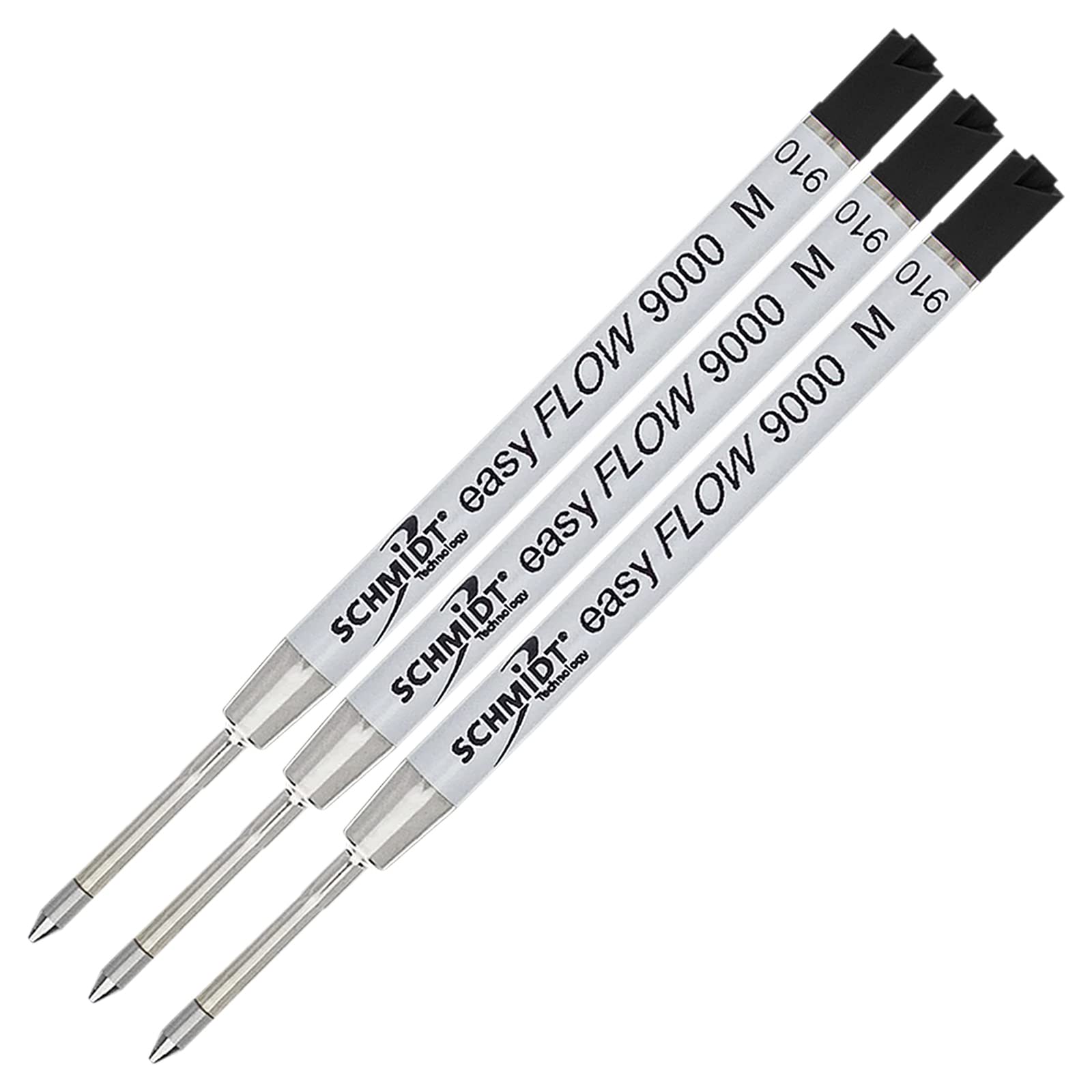
Schmidt’s easyFLOW 9000 is one of those refills that tends to come up whenever pen owners start complaining about ink that skips, dries out, or quits halfway through a page. This three-pack of black refills is aimed at people who already know they like the easyFLOW system or who are replacing a cartridge in a pen that takes the standard Schmidt format. It’s worth understanding what the refill actually does before buying, because it solves specific problems and creates a couple of minor ones of its own.
The easyFLOW 9000 is a pressurized refill. Inside the metal tube, a gas charge pushes ink toward the tip regardless of orientation, which means it writes upside down, at odd angles, and in conditions where a gravity-fed refill would start to fade. The practical effect shows up in everyday situations: taking notes while standing, writing on a clipboard held against a wall, or jotting something down on a vertical surface like a whiteboard edge or a taped-up sheet of paper. In normal desk use the difference is less dramatic, but the ink flow stays consistent from the first line to the last, and the refill doesn’t develop the faint scratchiness that some standard ballpoints show as they near empty.
The ink itself is a medium-viscosity black that dries reasonably quickly. On standard copy paper it sets within a few seconds, which matters for left-handed writers and for anyone signing documents or filling out forms in a hurry. On glossy or coated paper the drying time stretches out, and a finger dragged across a fresh line will smear. That’s true of most oil-based ballpoint inks, but it’s worth stating plainly: this is not a quick-dry gel refill, and it behaves like a ballpoint.
Line width and feel are where the easyFLOW 9000 sits in a slightly awkward spot. The tip writes a line that reads as a fine-to-medium ballpoint, with a small amount of feedback against the paper. It’s not as smooth as a gel or rollerball, and people coming from those formats may find it a little toothy at first. The trade-off is durability and reliability: the ink doesn’t feather on cheap paper, it doesn’t bleed through typical notebook stock, and it keeps working after sitting unused for weeks. For planners, logbooks, and forms that get filled in sporadically, that reliability is the main selling point.
Compatibility is the part buyers most often get wrong. The easyFLOW 9000 is a specific form factor, and it does not drop into every pen. It fits a range of Schmidt-compatible bodies and many kit pens, but it won’t fit a standard Parker-style G2 pen, and it won’t fit most generic retractable ballpoints without modification. Before ordering a three-pack, it’s worth checking the pen’s refill specification rather than assuming. The three-pack makes sense for someone with multiple compatible pens or a single pen they use heavily, since a pressurized refill tends to last a long time and buying in bulk saves a little per unit.
Compared with a conventional Parker-style G2 refill, the easyFLOW 9000 offers better performance at angles and in cold or damp conditions, but it costs more and fits fewer pens. Compared with a gel refill, it’s less smooth and less vivid, but far more resistant to drying out and smearing. Compared with a fountain pen, it requires no maintenance and no ink bottles, at the cost of character and line variation. None of these is strictly better; they suit different habits.
There are a few honest drawbacks. The refill is sealed and not refillable from a bottle, so when it’s done it’s landfill. The pressurized design means the ink can occasionally blob slightly if the pen is stored tip-down in a hot environment, though this is uncommon. And the black is a solid, slightly flat black rather than a deep, saturated one; anyone who cares about ink character will notice. The metal tube also shows wear and scuffing over time, which is cosmetic but visible on clear-bodied pens.
Who is this for? People who write in the field, on clipboards, at angles, or in unreliable conditions; anyone with a Schmidt-compatible pen who wants a refill that won’t quit mid-sentence; and left-handed writers who need ink that sets quickly on ordinary paper. It’s also a sensible choice for forms, logs, and records where a consistent, permanent-looking line matters.
Who is it not for? Writers who prioritize a smooth, wet, gel-like feel will likely be disappointed. Anyone with a pen that takes Parker-style G2 refills should look elsewhere, because this won’t fit. And people who want a refillable, low-waste writing setup are better served by a fountain pen or a converter-based system. For the right pen and the right habits, the three-pack is a practical, no-drama purchase; for everyone else, it’s a compatibility check away from being the wrong buy.