
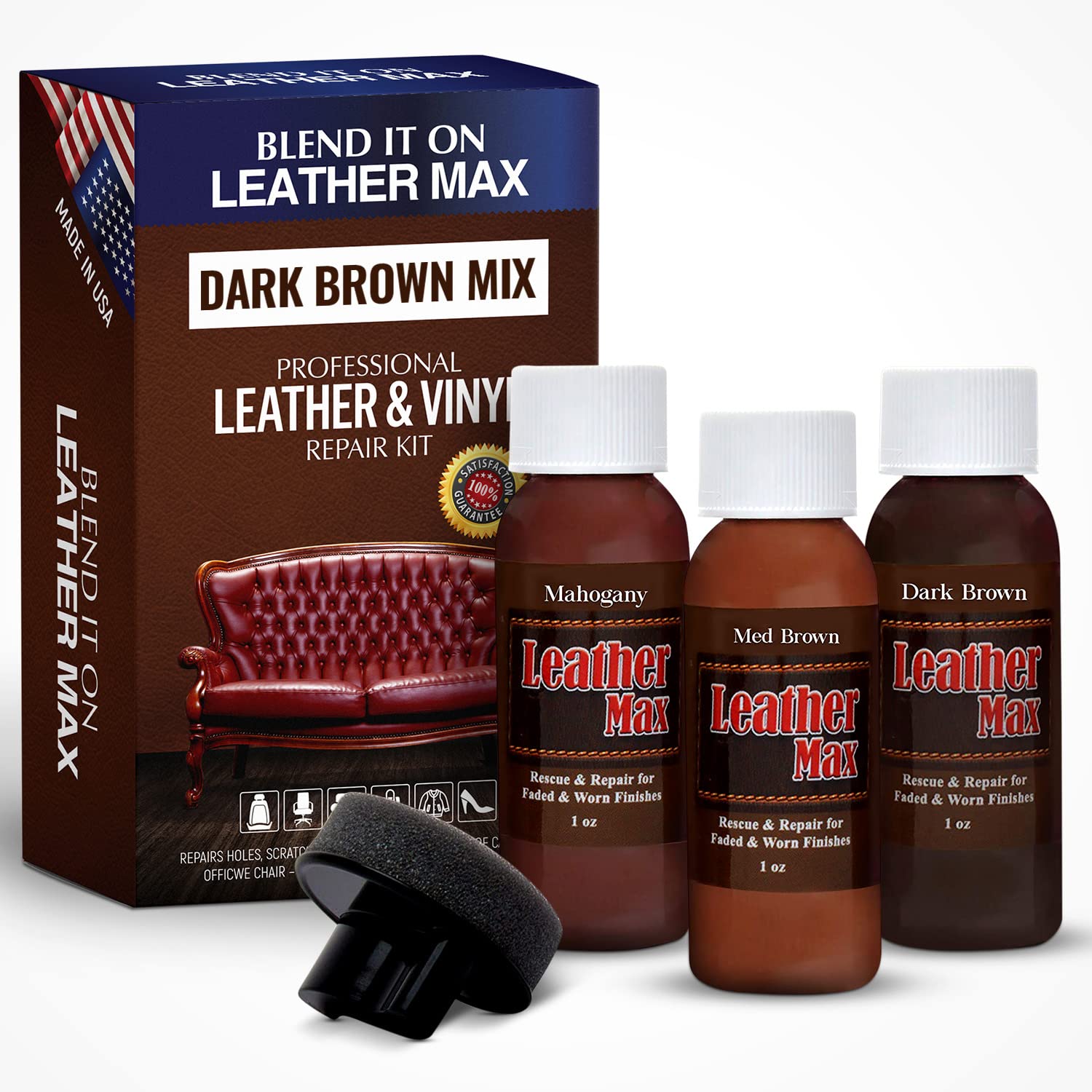
Leather and vinyl damage tends to sit in an awkward spot between cosmetic annoyance and real expense. A scuffed car seat or a cracked sofa cushion is rarely worth reupholstering, but it is also not something most people want to live with indefinitely. The Leather Max Dark Brown Mix Vinyl and Leather Repair Kit is aimed squarely at that middle ground: a consumer-level patch and recolor set for furniture, jackets, car interiors, and boots, sold on the promise that you can match brown tones without a mixing chart.
The kit’s defining feature is its color approach. Rather than asking you to blend pigments against a printed formula, it supplies a pre-mixed dark brown system intended to be adjusted by eye. In practice, that means dabbing a small amount of repair compound into a cleaned, prepped area, letting it cure, then layering color until it reads close to the surrounding material. The instructions are written for a first-timer, and the absence of a chart removes one common point of confusion, though it shifts more responsibility onto your own judgment of color and sheen.
What you get is a practical kit for small-to-medium repairs: a repair compound for filling cracks, tears, and worn edges; a dark brown colorant; and applicators. It is designed to work across both vinyl and leather, which matters because many sofas and car seats mix the two materials within a single surface. The compound is meant to be flexible once cured, so it can handle the slight give of a seat cushion or a jacket sleeve without cracking immediately. Expectations should stay realistic here. This is a surface-level repair, not a structural restoration, and deep tears or missing chunks of material will need backing support before any filler goes in.
Where the kit is likely to perform best is on the kind of damage people actually encounter: scuffed corners on a leather recliner, a worn patch on a car seat bolster, cracked vinyl on a boat seat, or a small nick in a boot. The dark brown palette is a sensible choice for a large share of household leather goods, since browns dominate furniture and automotive interiors. For these jobs, the process is straightforward: clean the area, apply filler in thin layers, sand or smooth if needed, then color and seal. The main skill involved is patience with layering, and the main risk is color drift if you rush the blending.
There are trade-offs worth naming. First, the pre-mixed approach is convenient but less precise than a full pigment-mixing kit, which lets you dial in an exact match using measured ratios. If your item is a distinctive shade, such as a reddish cognac or an olive-brown, the dark brown base may require careful tinting and may still land slightly off. Second, the finish is unlikely to be invisible under close inspection. A repaired area can look convincing from a normal viewing distance but may show a subtle texture or sheen difference up close, especially on smooth, high-gloss leather. Third, durability depends heavily on prep and on how much flex the repaired area sees; a boot that creases constantly is a harsher test than a static sofa arm.
Compared with dedicated leather dye kits, this product sits closer to the touch-up and filler category. Dye kits aim to recolor an entire panel and often require more surface area and more technique. A vinyl and leather repair kit like this one is better suited to localized damage, and it is generally more forgiving for a beginner. Compared with simply using a leather conditioner or a colored balm, the kit offers more filling power for actual cracks and tears, but it also demands more steps and drying time. It is not a substitute for professional reupholstery when the damage is extensive or the material is heavily degraded.
This kit suits renters, car owners, and households with a single worn piece they would rather patch than replace. It is a reasonable fit for someone comfortable with a little trial and error and willing to test the color on a hidden spot first. It is less suitable for anyone expecting a factory-perfect result, for very light or unusually tinted leathers, or for large tears where the underlying material has failed. Buyers should also check the color against their item before committing, since dark brown covers a wide range and the kit’s interpretation may not match every piece.
Overall, the Leather Max kit is a sensible, low-friction option for small brown leather and vinyl repairs, provided expectations are set around improvement rather than invisibility. Its strongest argument is the simplified color process; its weakest is the limited precision that comes with a single pre-mixed tone.