
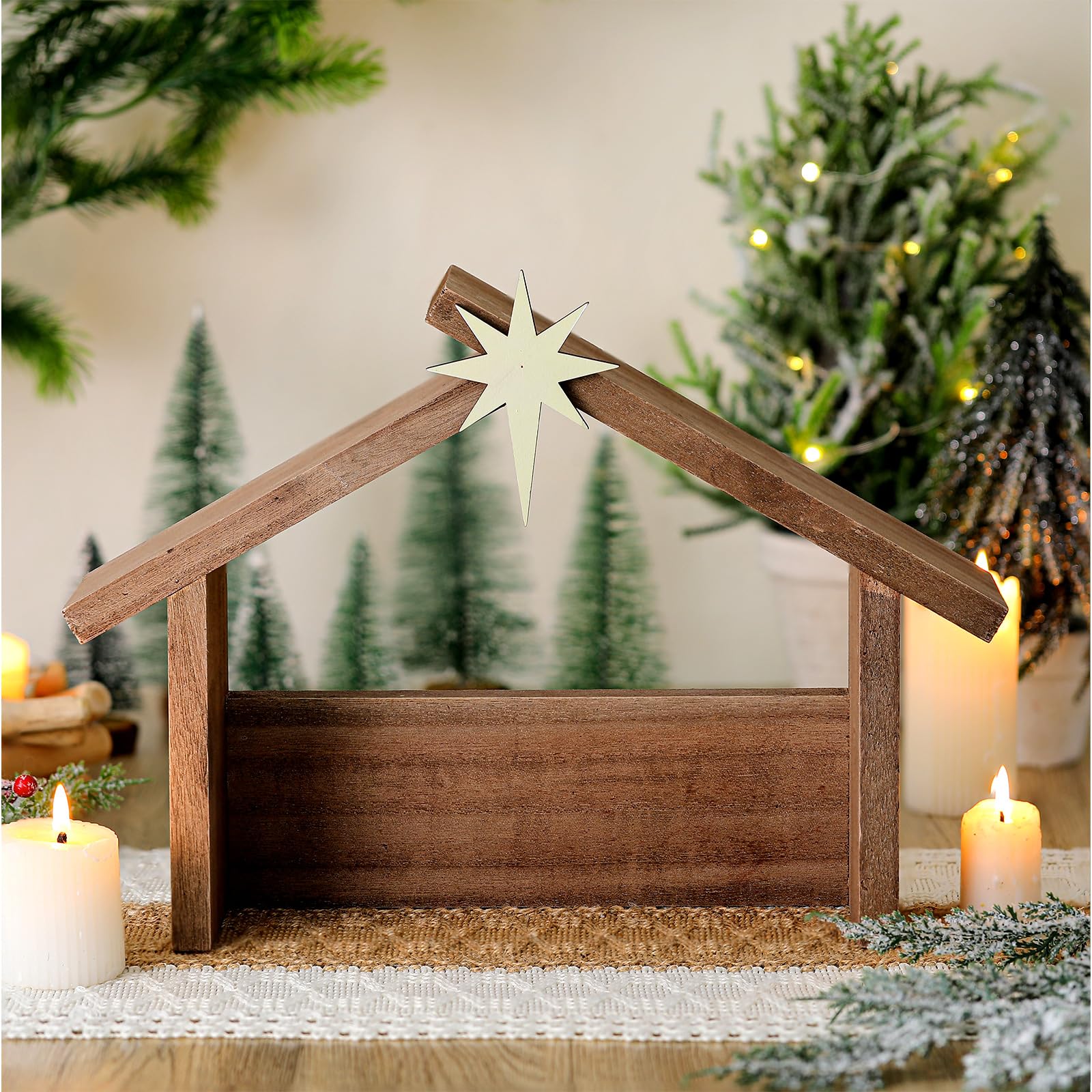
The Wesiti Christmas Wooden Nativity Manger is a tabletop stable creche built around a simple idea: give the Holy Family a physical structure that reads clearly from across a room. It falls into the broad category of decorative nativity stables—the wooden or resin shelters that hold figurines—rather than a complete figurine set. That distinction matters, because buyers often assume a “manger” listing includes the figures. In most cases, including this one, the stable is the product and the Holy Family, shepherds, and animals are sold separately or sourced from an existing collection.
The piece is constructed from wood, with a pitched roof and an integrated star element at the peak. The star is the most visually distinctive feature; it gives the silhouette a recognizable Christmas shape even at a distance, which is useful if the creche sits on a mantle, sideboard, or entry table where it is seen at an angle rather than straight on. The open-front design leaves the interior accessible for arranging figures, and the roof provides a natural overhang that frames whatever is placed inside.
In real-world use, this kind of stable is typically set up in early December and left in place through Epiphany. It works best as part of a layered display—on a bed of moss or straw, alongside candles, or as the centerpiece of a side table that otherwise sits empty. Because it is wooden rather than ceramic or resin, it tends to survive storage and handling better than fragile alternatives, though wood also means visible grain, joinery, and finish variation from unit to unit. Buyers should expect a rustic, slightly handmade look rather than a polished, factory-perfect surface.
- Material: Wood construction with a roof and star accent; finish and grain will vary between pieces.
- Format: Open-front stable designed to hold separately purchased figurines.
- Scale: Tabletop size, suited to standard creche figure sets rather than large floor displays.
- Assembly: Typically minimal, though some units may require attaching the roof or star.
The most significant limitation is scale ambiguity. Listings for wooden stables rarely communicate interior dimensions clearly enough for buyers to know whether their existing figures will fit. A stable that looks generous in a product photo can turn out to be cramped for a full Holy Family plus animals, and figures that are too tall will poke above the roofline or crowd the star. Anyone planning to use figures they already own should measure both the figures and the interior before committing. A second trade-off is stability: lightweight wooden stables can be tipped by pets or bumped by children, and the star at the peak is a natural target for curious hands. Placement on a stable, out-of-reach surface is advisable.
Compared with resin or ceramic nativity stables, the wooden approach trades fine molded detail for durability and a warmer, more natural look. Resin stables often include sculpted textures—stone walls, thatch, carved beams—that wood cannot match at this price level. On the other hand, wood resists chipping and tends to age more gracefully; a resin stable that takes a fall may lose a corner, while a wooden one usually survives with a scuff. Compared with complete nativity sets that bundle stable and figures together, this product demands more effort from the buyer, who must source figures separately and confirm they fit. That is a real inconvenience, though it also allows for customization—mixing figures from different sets or adding pieces over time.
Finish quality is the area where expectations should be tempered. At this tier, wooden decor often arrives with minor imperfections: uneven stain, rough edges on cutouts, or slightly misaligned roof pieces. These are usually cosmetic and consistent with the rustic aesthetic, but buyers expecting furniture-grade craftsmanship will be disappointed. The star, in particular, may be a simple cutout or applied piece rather than an illuminated feature; anyone wanting a lit star should plan to add a separate battery-operated light.
This stable is best suited to households that already own nativity figures or intend to build a set gradually, and to those who prefer a natural, understated look over ornate detail. It also works well for families with young children, since wood tolerates handling better than ceramic. It is less suitable for buyers who want a complete, ready-to-display set out of the box, for anyone needing a large floor-scale creche, or for those who expect precise, uniform finishing. As a decorative frame for a collection rather than a standalone centerpiece, it does its job without fuss—provided the figures fit and the buyer accepts the handmade variation that comes with wooden construction.