
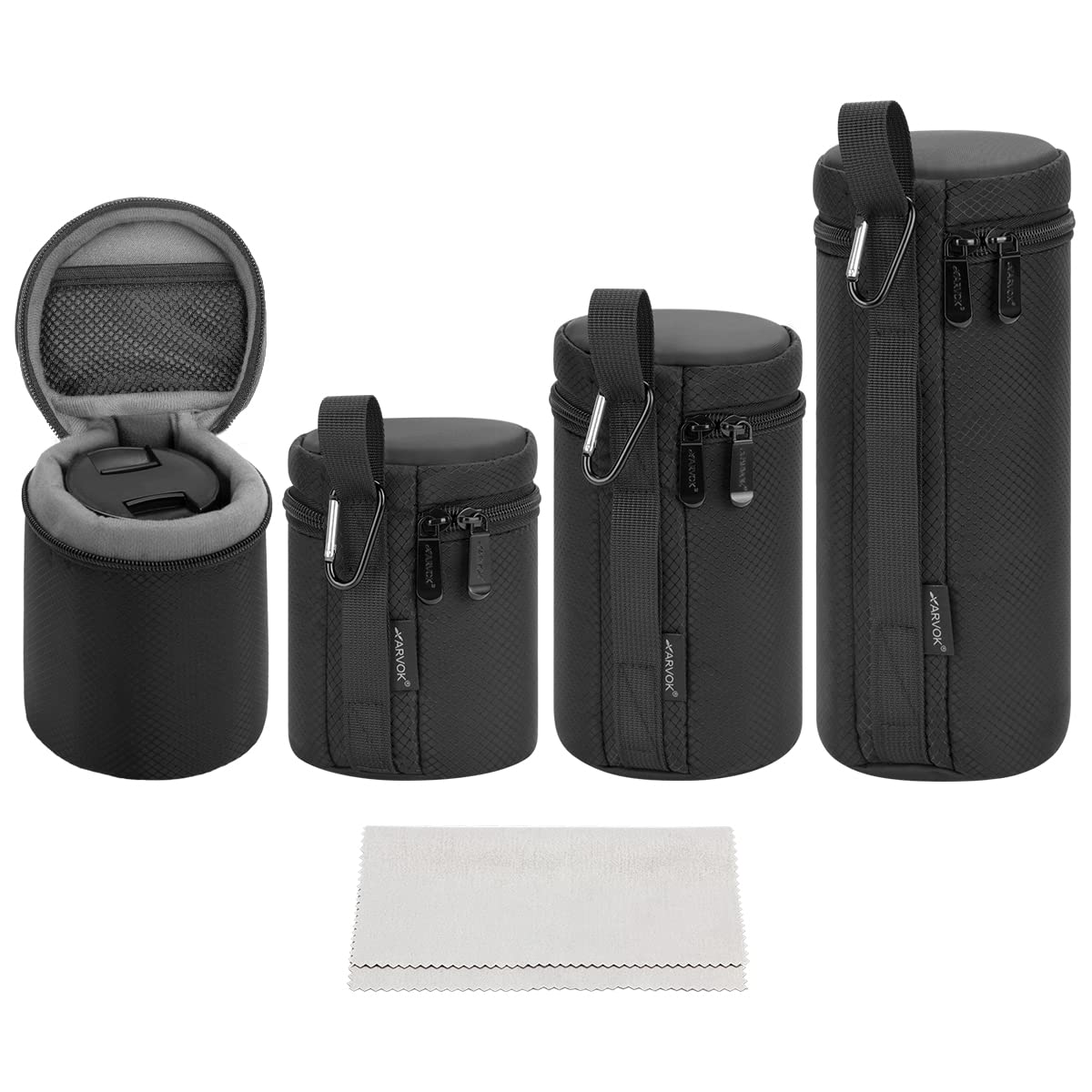
Lens pouches occupy an odd corner of camera gear. They are rarely exciting, often overlooked, and yet many photographers end up buying a set once they realize their bag’s dividers are not enough to keep lenses from knocking against each other. The ARVOK Camera Lens Case is a four-pack of padded, water-resistant drawstring pouches sold in graduated sizes, aimed at the photographer who wants a simple layer of protection without committing to a hard case or a full insert system.
The set is built around a straightforward idea: each pouch is a soft, cylindrical bag with a thick padded wall, a drawstring or toggle closure at the top, and a fabric exterior that sheds light moisture. The four sizes are meant to accommodate a range of lenses, from small primes up to longer telephoto zooms, and the branding leans on compatibility with Nikon, Tamron, Sigma, Pentax, Sony, Fuji, and Panasonic mounts. In practice, the sizes are generic rather than mount-specific, so the fit depends on the physical dimensions of the lens rather than the brand printed on the barrel.
How these get used in practice
The most common scenario is bag organization. A photographer with three or four lenses in a shoulder bag or backpack can drop each lens into its own pouch, which reduces the chance of barrel-to-barrel contact and adds a bit of cushioning against bumps. The pouches also work as a lightweight storage option at home, keeping lenses dust-free on a shelf, and they are handy for travel when a hard case would be overkill. Because they are soft and collapsible, they pack down flat when empty, which makes them easy to toss into a bag as backup protection.
The drawstring closure is the main functional element. It cinches the top around the lens, and the padded body covers the barrel and most of the front element area. That said, the closure is not a sealed, waterproof system. The water resistance is best described as splash-resistant or weather-resistant for light rain and spills, not for submersion or sustained downpours. Anyone expecting dry-bag performance will be disappointed.
What the four sizes actually mean
- The smallest pouch suits compact primes and short lenses, roughly in the range of small 35mm or 50mm primes.
- The mid sizes cover standard zooms and medium primes, which is where most everyday lenses will land.
- The largest pouch accommodates longer zooms, though very long telephoto lenses will likely exceed even the biggest size.
Because the sizing is approximate, buyers should measure their lenses rather than assume a pouch will fit based on the focal length alone. A wide lens with a large front element can be wider than a longer lens with a narrow barrel, and the pouch diameter matters as much as length. This is a common source of frustration with generic pouch sets, and ARVOK is no exception.
Trade-offs worth knowing
The padding is the main compromise. These are thick enough to absorb minor knocks and prevent scuffs, but they are not impact protection in the way a hard case or a well-padded camera insert is. A drop onto a hard surface is still a drop onto a hard surface. The pouches also add bulk to a bag, and four padded cylinders take up more room than four bare lenses. Photographers who pride themselves on a compact kit may find the pouches eat into usable space.
Another limitation is access. Getting a lens in and out of a drawstring pouch is slower than pulling it from an open divider slot, which matters during fast-changing situations like event work or street photography. The pouches are better suited to transport and storage than to rapid lens swapping in the field.
How this compares to alternatives
The closest comparison is a padded camera insert or a dedicated lens case from a bag manufacturer. Inserts offer structured dividers and often better padding, but they are bulkier and more expensive, and they do not protect individual lenses once removed from the bag. Neoprene lens covers are another option; they are lighter and stretch to fit, but they offer less padding and tend to be less water-resistant. The ARVOK set sits in the middle: more protection than a simple cloth wrap, less structure than a hard case, and cheaper than most branded alternatives. For a four-pack, the value proposition is reasonable, though the generic sizing means not every pouch in the set will be useful to every buyer.
Who it suits and who it does not
These pouches make sense for hobbyists and enthusiasts who keep a modest collection of lenses and want inexpensive, lightweight protection for bag transport and shelf storage. They are also a sensible pick for travelers who want to consolidate lenses in a single backpack without buying a new bag. They are less suitable for professionals who need fast access, for anyone shooting in heavy rain, or for photographers with very large telephoto lenses that exceed the largest size. Buyers expecting hard-case-level protection should look elsewhere.
Overall, the ARVOK four-pack is a practical, unglamorous accessory that does a modest job at a modest price. It is not a substitute for a well-organized camera bag, but as a secondary layer of protection and organization, it earns its place for the right user.