
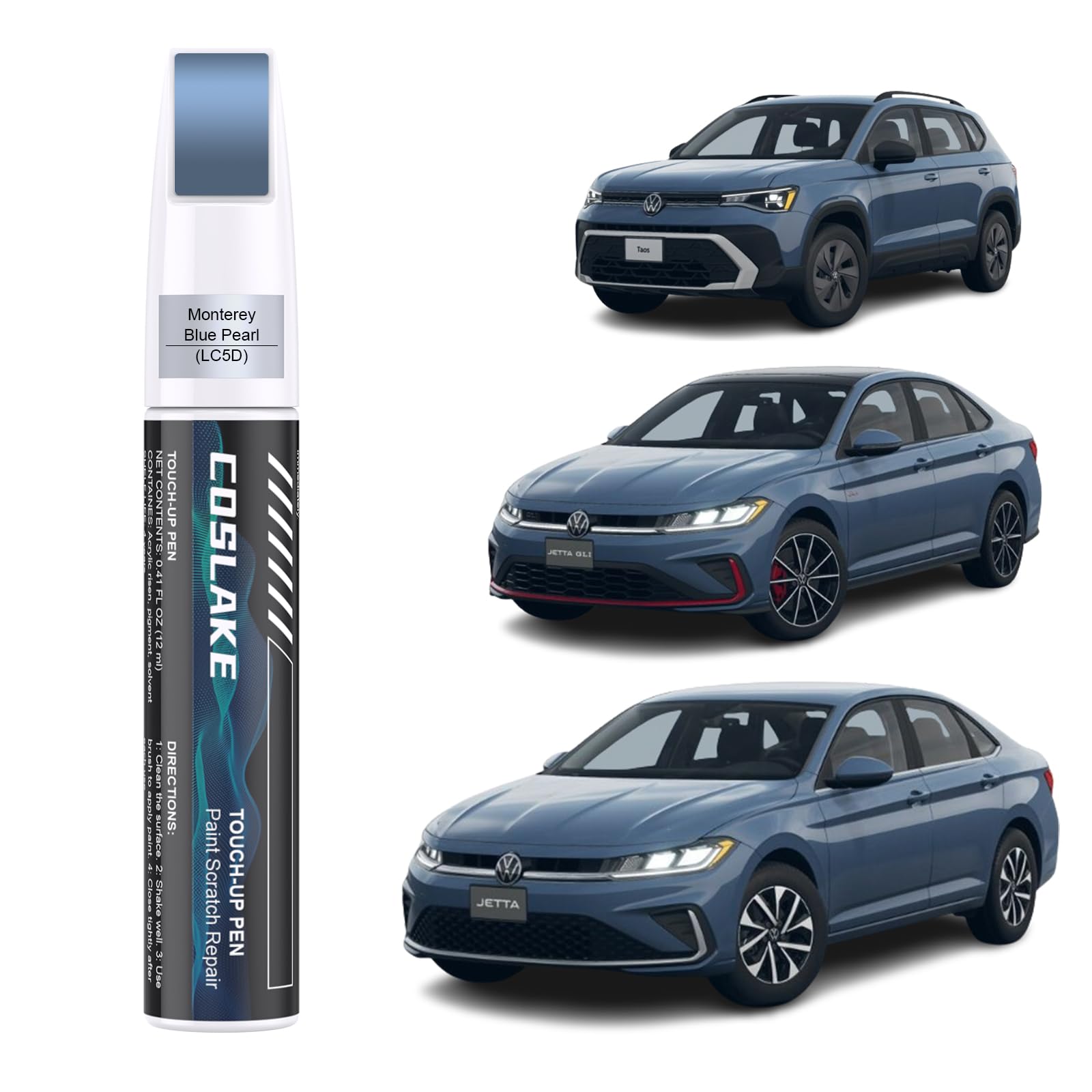
Touch-up paint is one of those purchases people make in a small panic. A door ding appears in a parking lot, a shopping cart leaves a white scuff on a blue fender, and suddenly the priority is finding something that matches the factory color before rust sets in. The COSLAKE Car Touch Up Paint in Monterey Blue Pearl, listed under the Volkswagen code LC5D, is aimed squarely at that moment. It is a small, inexpensive kit meant to cover chips and scratches rather than restore a panel, and it should be judged on those terms.
The product is built around a specific factory color code. Monterey Blue Pearl is a metallic finish used on several Volkswagen models, and the LC5D designation is the part that matters most. Paint retailers live or die on code accuracy, and COSLAKE’s approach is to sell pre-mixed bottles keyed to manufacturer codes rather than universal colors. That is the right model for this category. A buyer’s first job is to confirm the code on the vehicle’s build sticker or door jamb, because Monterey Blue Pearl has appeared on different models across different years, and a code that looks right on a listing can still be wrong for a particular car.
In use, the kit is straightforward. The paint arrives in a small bottle with an applicator, and the process is the familiar one: clean the chip, remove loose flakes, apply thin layers, and let each layer dry before adding another. Thin coats matter more with metallic and pearl finishes than with solid colors, because the flakes need to lie flat to read correctly in sunlight. The included applicator is adequate for small chips and thin scratches, though it is not a precision tool. For a chip the size of a pencil eraser, it works. For a long key scratch or a wide scrape, the applicator becomes clumsy and a fine brush or a touch-up pen with a narrower tip would give more control.
Color match is the central question, and the honest answer is that results vary by panel and by lighting. A pre-mixed bottle cannot account for how a particular car’s paint has aged. Monterey Blue Pearl on a five-year-old Volkswagen that has spent its life outdoors will not look identical to fresh factory paint, and no touch-up product can fully close that gap. The COSLAKE paint reads close to the factory shade in most lighting, but pearl finishes are directional. Viewed from one angle the repair may blend reasonably well; from another, the metallic flake can look slightly denser or lighter than the surrounding panel. For a chip low on a door or behind a wheel arch, this is a non-issue. For a chip on the hood or the top of a fender, where light hits directly, the repair will be visible on close inspection even when the color is right.
Durability is reasonable for what this is. Cured touch-up paint holds up to washing and normal weather, but it is not a substitute for a proper base coat and clear coat system. The kit does not include a separate clear coat in the standard configuration, and pearl finishes generally benefit from one to protect the flake layer and add gloss. Without it, the repaired spot can look slightly flatter than the surrounding paint and may fade faster over time. Some buyers add a small amount of clear touch-up paint over the repair, which is a sensible step for anything on a horizontal surface.
Compared with the alternatives, the trade-offs become clearer. A body shop repair with a blended panel is the only way to get an invisible result, but it costs many times more and is hard to justify for a single chip. A generic universal touch-up pen is cheaper but rarely matches a specific pearl color, and the mismatch is usually obvious. Paint-matched aerosol cans sit between the two: they cover larger areas better than a bottle and applicator, but they are harder to control on small chips and require masking to avoid overspray. The COSLAKE bottle fits the narrow middle ground of small, isolated damage, and it does that job without pretending to do more.
There are practical limitations worth stating plainly. The paint needs to be shaken thoroughly, and pearl pigments settle, so a half-used bottle stored for months may not mix back to the same consistency. Cold weather slows curing, and applying in direct sun can cause the paint to skin over too quickly. The kit also does nothing about surface preparation beyond what the user provides; a chip with rust already starting needs the rust removed first, or the repair will fail regardless of color match.
This product suits someone with a small stone chip or door edge nick on a Monterey Blue Pearl Volkswagen who wants to prevent corrosion and make the damage less noticeable from a few feet away. It is a reasonable fit for a careful owner willing to apply thin coats and accept a visible repair up close. It is not suitable for someone expecting a flawless, invisible finish, for large scrapes or dented panels, or for a car whose paint has faded enough that a fresh factory mix no longer matches. Buyers should also verify the LC5D code against their own vehicle before ordering, since that single detail determines whether the product is useful or merely close.