
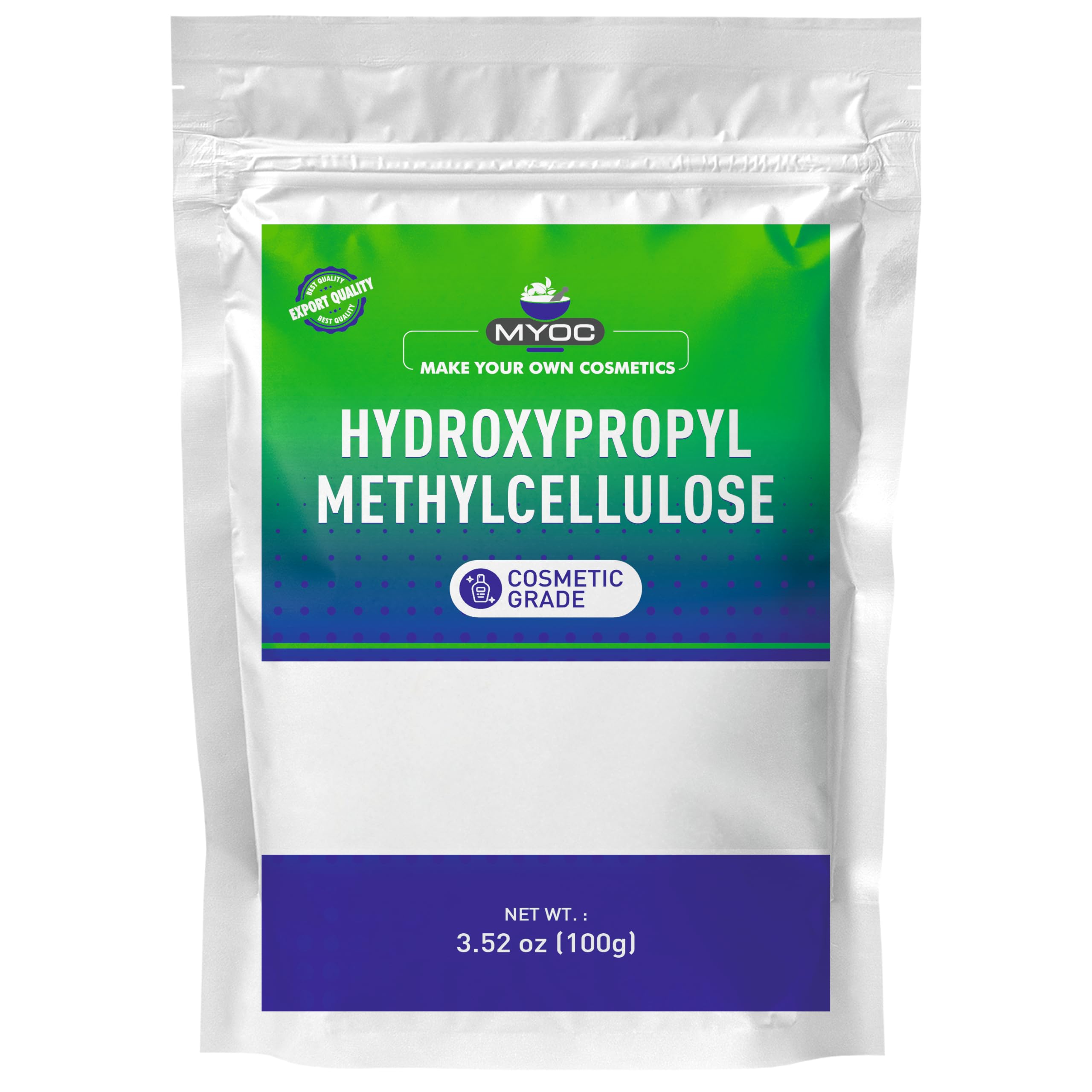
Hydroxypropyl methylcellulose (HPMC) is a staple in DIY cosmetics for good reason: it’s a water-soluble cellulose derivative that thickens, stabilizes, and forms clear gels without the need for heat or neutralization. MYOC’s 100g cosmetic-grade offering is aimed at formulators who want a reliable, easy-to-disperse powder for serums, gels, and creams. But how does it perform in real-world use? This review breaks down what you can expect, where it falls short, and who should consider it.
In practice, HPMC is used to create gel textures for products like facial serums, hair gels, and lubricants. It’s also a common thickener for cream formulations, helping to achieve a smooth, non-greasy feel. The MYOC product comes in a resealable pouch, which is convenient for storage, though the lack of a scoop can be a minor inconvenience. The powder itself is fine and white, typical of cosmetic-grade HPMC.
One of the key functional features of HPMC is its ability to form gels at low concentrations—often around 1-2%—and its tolerance to electrolytes, which makes it suitable for formulations with salts or active ingredients. It also provides good freeze-thaw stability and is compatible with a wide pH range. However, achieving a consistent gel can be tricky: HPMC requires proper dispersion to avoid clumping. The common method is to disperse the powder in hot water (above 80°C) and then cool it while stirring, or to use a slurry method with a non-solvent like glycerin. MYOC’s product doesn’t come with detailed instructions, so beginners may need to consult external resources.
In our test batches, the HPMC dissolved well when using the hot/cold method, yielding a clear, viscous gel. At 2%, the gel was thick enough for a hair styling product, though it felt slightly stringy. For a facial serum, a lower concentration (0.5-1%) provided a nice slip without tackiness. The powder is relatively easy to work with, but like all HPMC, it can form lumps if added directly to cold water—so patience and proper technique are required.
Compared to xanthan gum, another common thickener, HPMC produces clearer gels and has a less slimy feel. Xanthan gum is more forgiving to use but can leave a sticky residue. HPMC also offers better electrolyte tolerance, making it preferable for formulations with salts. However, xanthan gum is effective at lower concentrations and doesn’t require heating, which might be a trade-off for those who prefer cold-process methods. Another alternative, carbomer, requires neutralization and produces a different, more brittle gel. HPMC sits in a middle ground: it’s versatile but demands a bit of know-how.
One limitation of MYOC’s HPMC is the packaging: the 100g size is generous for personal use, but without a desiccant or tight seal, the powder can absorb moisture over time, leading to clumping. It’s best to transfer to an airtight container. Also, the product is cosmetic grade, so it’s not suitable for food or pharmaceutical use—something to keep in mind if you’re formulating for others.
Who is this for? DIY enthusiasts and small-scale formulators who are comfortable with basic lab techniques and want a reliable, clear-gel thickener will find this useful. It’s also suitable for those making hair gels or lubricants who need electrolyte compatibility. However, it’s not ideal for complete beginners who want a no-fuss thickener—xanthan gum might be a better starting point. Nor is it for those seeking a certified organic or natural-only ingredient, as HPMC is synthetically modified (though it is derived from cellulose).
Overall, MYOC’s HPMC is a solid choice for experienced DIYers. It performs as expected, but the lack of usage instructions and moisture-sensitive packaging are minor drawbacks. If you’re willing to learn the dispersion technique, it’s a versatile addition to your formulator’s toolkit.