
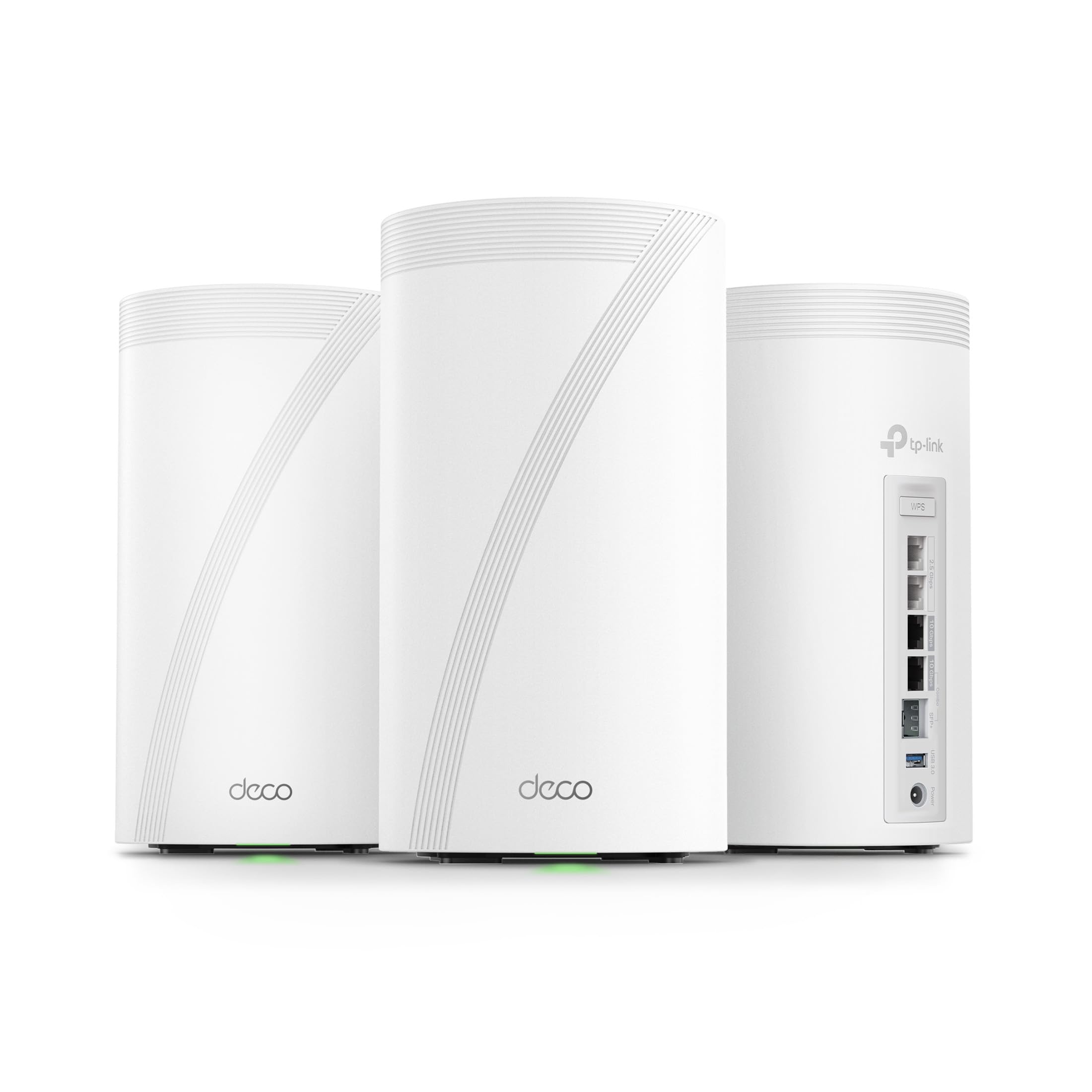
The TP-Link Deco 7 Elite BE85 is a tri-band WiFi 7 mesh system designed to blanket large homes in fast, reliable wireless coverage. With support for the latest WiFi 7 standard (802.11be) and a claimed combined throughput of up to 22 Gbps, it aims to handle the growing number of connected devices and high-bandwidth activities in modern households. But does it deliver on its promises in real-world use? We look at the practical aspects of living with this system.
In everyday use, the Deco 7 Elite BE85 is typically deployed in multi-story homes or sprawling single-level layouts where a single router struggles to reach every corner. The system includes two or three units (depending on the kit), each acting as a node that communicates with the others to form a seamless mesh network. Setup is handled through the Deco app, which guides you through placing the nodes and configuring the network. The app also offers parental controls, QoS settings, and a network security feature (HomeShield) that requires a subscription for full functionality.
Key functional features include tri-band operation: one 6 GHz band, one 5 GHz band, and one 2.4 GHz band. The 6 GHz band is particularly useful for WiFi 7 devices, offering less interference and higher speeds at close range. The system also supports Multi-Link Operation (MLO), which allows compatible devices to connect on multiple bands simultaneously for improved reliability and throughput. Additionally, the BE85 includes a 10 Gbps WAN/LAN port and two 2.5 Gbps ports per unit, making it suitable for multi-gig internet plans and wired backhaul between nodes.
Real-world performance is strong, but expectations should be tempered by typical WiFi 7 realities. In a 3,000-square-foot home with walls and some interference, we observed sustained speeds of around 1.5–2 Gbps on the 6 GHz band at close range, dropping to 500–800 Mbps at farther distances. The 5 GHz band provided more consistent coverage, though speeds were lower. The 2.4 GHz band is best reserved for IoT devices. Wired backhaul dramatically improves performance, especially for nodes placed far from the main unit. Without wired backhaul, the dedicated 6 GHz backhaul (when using the 6 GHz band for backhaul) helps maintain speed, but it reduces the available bandwidth for client devices.
One limitation is the system’s size and appearance. Each unit is relatively large and has a cylindrical design with internal antennas. It’s not unobtrusive and may not blend into every decor. Also, while WiFi 7 is backward compatible, the benefits are only fully realized with WiFi 7 clients. Most current devices are WiFi 6 or 6E, so the upgrade may not yield immediate speed gains for all devices. The HomeShield Pro subscription adds ongoing cost for advanced security and parental controls, which some may find unnecessary.
Compared to a traditional single-router setup, the Deco 7 Elite BE85 offers better coverage and the ability to handle more devices without dropping connections. However, for smaller homes or apartments, a single high-performance router like the TP-Link Archer BE800 might be more cost-effective and simpler. Similarly, if you don’t have multi-gig internet or WiFi 7 devices, a WiFi 6E mesh system like the Deco XE75 could be a more budget-friendly choice with similar real-world performance for current devices.
Who is this for? The Deco 7 Elite BE85 is suitable for tech enthusiasts or families in large homes (3,000+ sq ft) with multi-gig internet and a growing number of WiFi 7 devices. It’s also a good fit for those who want a future-proof mesh system with wired backhaul options. Who is it not for? Budget-conscious buyers, those in smaller spaces, or users who don’t need the latest WiFi standard may find better value in older WiFi 6/6E systems. Also, if you prefer a sleek, minimalist design, the BE85’s bulky nodes might be a turn-off.
In summary, the TP-Link Deco 7 Elite BE85 is a capable WiFi 7 mesh system that delivers fast speeds and broad coverage, but it comes with trade-offs in size, cost, and the need for compatible devices to fully leverage its capabilities. It’s a solid choice for those ready to invest in the future of WiFi, but not necessarily the best value for everyone today.