
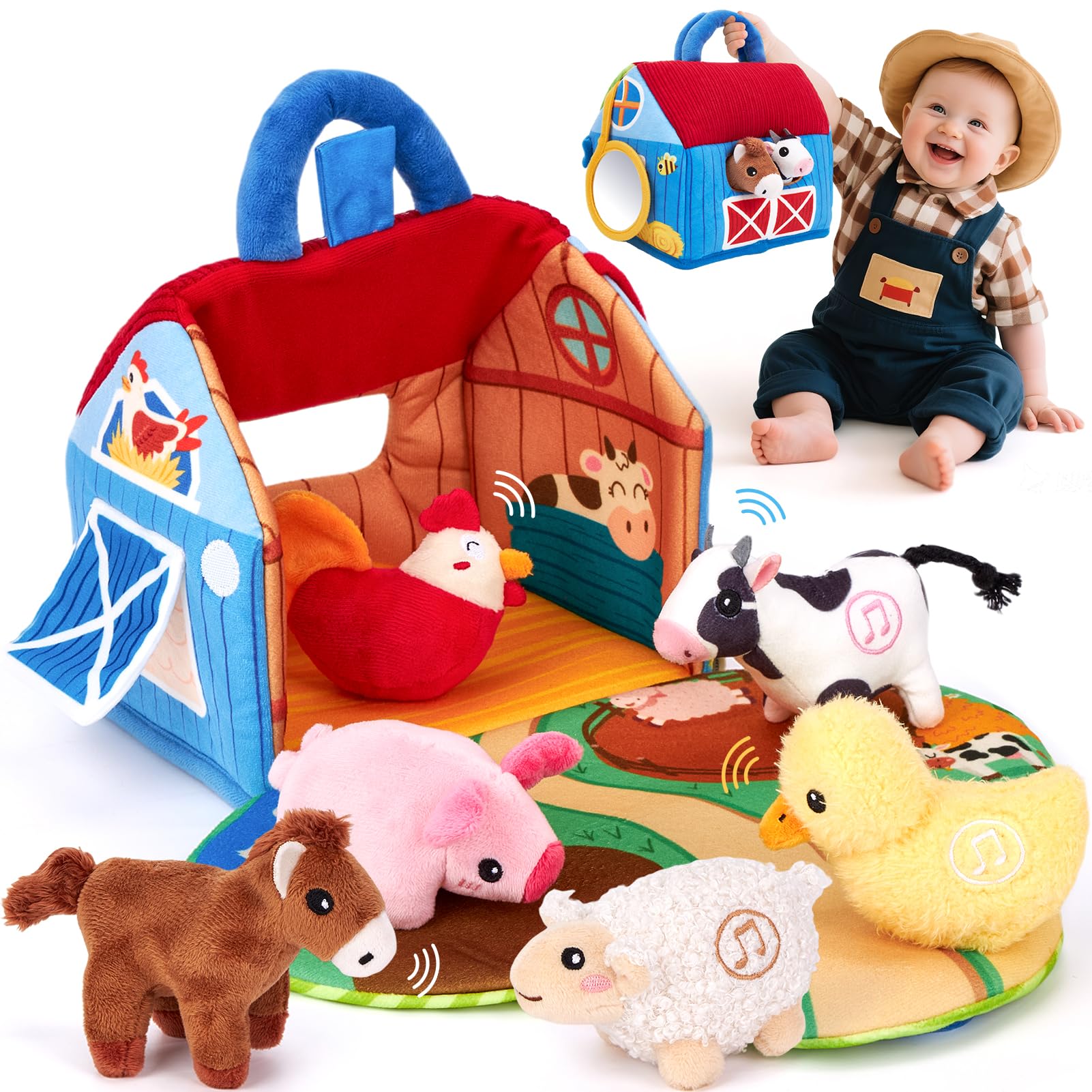
The Hahaland Surprise Barn Farm Animals set is one of those infant toys that tries to do several things at once: it is a shape-sorting barn, a collection of animal figures, and a sound-and-word device. For parents of babies in the six-to-twelve-month range, that combination is common enough in the toy aisle, but the execution varies a lot between brands. This review looks at what the toy actually does, how it tends to be used at home, and where it falls short.
The core concept is straightforward. A barn-shaped container holds several farm animal figures, and pressing or inserting the animals triggers sounds and spoken words. The “surprise” element refers to the way the animals are revealed or activated, which gives the toy a repetitive cause-and-effect loop. That loop is the main reason it holds a baby’s attention at this age. Infants around six to nine months are learning that their actions produce results, and a toy that reliably responds to a press or a drop fits that developmental stage well.
In practice, the toy tends to live on the floor during tummy time or seated play. Parents often report using it as a short-attention activity rather than a long session toy. The animal figures are sized for small hands, and the barn opening gives babies something to reach into, which supports grasping and transferring objects between hands. The sound output includes animal noises and simple word labels, which adds a language exposure layer that plain shape sorters lack.
- What it includes: a barn-style container, multiple farm animal figures, and battery-powered sound and word playback.
- Interaction style: press, insert, or trigger the animals to produce sounds and spoken words.
- Target age: marketed for six to twelve months, though the upper end of that range will likely outgrow it sooner.
- Power: typically requires standard batteries, which are usually not included.
The functional strengths are real but modest. The cause-and-effect design is well matched to the developmental window, and the combination of animal sounds with word labels gives it slightly more educational value than a purely mechanical toy. The figures are generally chunky enough to avoid being a choking hazard for the stated age, though supervision is still necessary, as with any small-parts toy.
The limitations are worth stating plainly. First, the sound quality on toys in this category is rarely good, and the volume can be louder than parents expect, with no fine-grained volume control on many units. Second, the “surprise” mechanic becomes predictable quickly; babies who play with it daily may lose interest within a few weeks. Third, the battery compartment and speaker mean the barn itself is not fully washable, so it needs wiping rather than rinsing, which matters for a toy that ends up in a baby’s mouth. Finally, the twelve-month upper age range is optimistic. Most one-year-olds will have moved on to toys with more open-ended building or stacking potential.
Compared with a basic shape sorter or a set of plain wooden animals, this toy offers more sensory feedback but less durability and less open-ended play. A wooden animal set will last for years and survive being chewed and dropped; the Hahaland set’s electronic components make it a shorter-lived purchase. Compared with electronic learning tables, it is smaller, cheaper, and less overwhelming, which some parents prefer for young infants. The trade-off is that it does less.
Who is it for? It suits parents of babies roughly six to ten months who want a compact, floor-level toy that encourages reaching, grasping, and early cause-and-effect learning, and who do not mind battery replacement and wipe-clean maintenance. It is also a reasonable gift for a first birthday if the child is on the younger side of that milestone.
Who is it not for? Families looking for a long-term toy, a fully washable item, or something that grows with the child past infancy will likely be disappointed. Parents who prefer wooden, battery-free toys should skip it. And anyone expecting the word-learning element to be substantial should temper expectations; the vocabulary is limited and repetitive, and it functions more as sound exposure than as a teaching tool.
Overall, the Hahaland Surprise Barn is a serviceable, mid-range infant toy that does what it claims for a short developmental window. It is not built to last beyond that window, and its electronic nature limits how it can be cleaned and reused. For the price and the age range, that is a reasonable trade-off, provided expectations are set accordingly.